
Broken Finances to Broken Hands

Closing out The Far Middle’s 2023 run, Nick presents a unique sports dedication that continues recent dedications combining sports with several interesting historical angles.

For episode 136, Nick explores baseball’s “long forgotten Federal League” of 1913 to 1916. While a failure, it was a “wonderful experiment,” and a great example of “a risk-taking endeavor by doers in the chaotic world of free-market American capitalism.”

From the business of early 1900s baseball, Nick connects to the business of baseball today, specifically the broken finances and unsustainable business model of the San Diego Padres. “It is striking how similar the failed business model and state of the Padres is to a government, say like Illinois or New York City, or corporations that are sitting on shaky business plans, or with the higher education model of today,” says Nick.

Nick moves from the Padres’ financial mess to examining Argentina who faces a similar and more serious financial situation. “The root causes of Argentina’s woes are a toxic cocktail of massive government borrowing and lax monetary policy and inflation,” explains Nick, proceeding to examine the similar economic trouble facing Argentina and the United States. While Nick is hopeful newly elected Argentine President Javier Milei can bring about reform, he worries greatly for America if we don’t course correct.

Looking ahead to 2024, Nick explores what the Fed might do with interest rates next year. “Everyone wants a reduction in rates and cuts from the Fed,” says Nick. “But wanting it and getting it are two different things. I’m convinced the Fed will try to start to cut rates soon…But inflation doesn’t care. In fact, inflation will flare even more if rate cuts start too soon.”

In closing, and as New Year’s Eve looms a few days away, Nick wishes a happy birthday to Sir Philip Anthony Hopkins who will turn 86 this December 31. Nick reflects on Hopkins life and career, including his working-class upbringing. Nick recalls an admirable line Hopkins said about his father that speaks to Hopkins’ character, “Whenever I get a feeling that I may be special or different, I think of my father and I remember his hands – his hardened, broken hands.” And if you haven’t seen Hopkins in The Elephant Man, add it to your watchlist this winter.

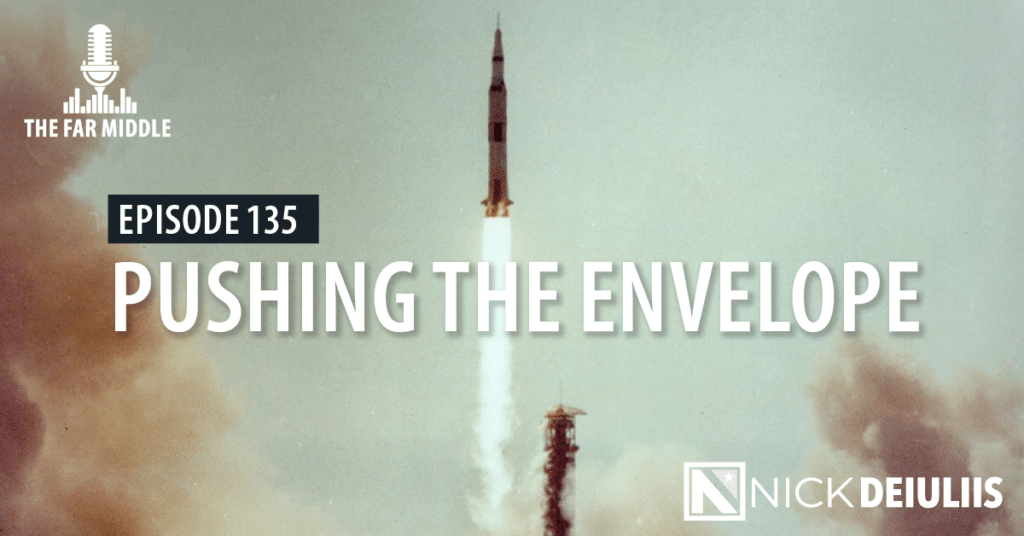
Pushing the Envelope

Hello Far Middle friends, Nick Deiuliis is back to talk with you again. Episode 135 begins with a sports dedication taking listeners from the gridiron to the stars as Nick honors wide receiver turned engineer and astronaut, Leland Melvin.

Nick describes Melvin’s career from the football field to NASA as a “made for Far Middle topic and dedication.” The tribute to Melvin follows a recent string of dedications celebrating athletes (such as Ted Williams, Nile Kinnick, Archie Moore) who’ve pushed the envelope to achieve greatness beyond their sports careers.

“I’ve always been interested in space because of the science and the constant innovation found in the associated industries, but I never wanted to be an astronaut,” says Nick. “Just too much risk for me to life and limb, which leads to our first connection for this episode, how innovation and risk in the profession of astronaut, they came together in the late 1960s during the Apollo space missions.” Nick proceeds to discuss how the Apollo astronauts devised an innovative insurance system autographing postage envelopes.

Next, Nick recounts a remarkable and inspiring story on the lifelong impact that educators, specifically elementary school teachers, can have on individuals. As for something less inspiring, Nick discusses Encyclopedia Britannica’s grossly misleading Vietnam War timeline.

“Encyclopedia Britannica tells only part of the true story and only the part that fits a narrative favored by the Left,” says Nick. “Frankly, it reads as if written by a communist and someone who holds a grudge against the United States. Tell the whole truth, Encyclopedia Britannica, not selected pieces of it to skew the uninformed looking to become informed. Those who served in Vietnam deserve at least that much. As do young students looking for objective and balanced resources to tell a complete story.”

Students and education are a frequent theme this episode as Nick next explains how a CNX Mentorship Academy student recently taught him about “sleepy sickness.” Formally known as encephalitis lethargica, the disease was a global epidemic that resulted in hundreds of thousands of deaths in the 1920s.

From sleepy sickness Nick connects “to what most people desire to hear when trying to sleep—the sound of silence.” With that, Nick closes by looking back on Simon & Garfunkel’s hit “The Sound of Silence.” And Nick offers “the rest of the story” (a frequent theme this episode) highlighting the connection of the song and album, Wednesday Morning, 3 A.M., to Art Garfunkel’s longtime friend Sandy Greenberg.

Education in America

The Far Middle episode 134 honors not only a sports legend whose record-holding World Light Heavyweight Champion reign spanned a decade, but also simply a great American. That individual, born 110 years ago on the date of this installment’s release, is none other than “The Mongoose,” Archie Moore.

For those saying, “Archie who,” Nick explains that Moore “basically did it all.” He revisits Moore’s acclaimed boxing career, dedication to youth mentorship, acting roles, and service under the Department of Housing and Urban Development. “Archie Moore set amazing standards for vitality and competitiveness over an extended period of time in his chosen profession,” adds Nick, providing a pivot to this episode’s first connection and principal topic: education in America, and particularly education in our large cities.

Nick starts in the Windy City where the city’s Leftist mayor has decided to no longer grade public schools based on student proficiency, but rather on how much schools are spending. Highlighting that per student funding in Chicago public schools sits just below $30,000, “an unbelievable amount for so little in return,” Nick asks where it’s going for so little in return. The answer? Not to the students nor to good teachers, but rather to bloated administrative staff, the bureaucracy, and to the public teachers union coffers (and the politicians they support).

Nick leaves Chicago and heads west to Oakland for an insight on what public teachers unions are focused on these days. Not academics, but rather drought resistant trees and climate justice days. From Oakland, Nick heads down to Tempe, Arizona, to discuss a paper from Arizona State’s Walter Cronkite School of Journalism, titled, “Beyond Objectivity: Producing Trustworthy News in Today’s Newsrooms.” Juxtaposed to academia’s views on the media, Nick highlights survey data to shed light on where the American public sits with respect to objectivity in journalism and media.

The episode’s discussion then connects to a great educator who “very few people today ever heard of, which I suppose is yet another failing of media,” says Nick. “Early November this year marked the 50th anniversary of an assassination of a hero educator in Oakland, California, and his name was Marcus Foster.” Listen as Nick reflects on Dr. Foster’s exemplary career that was tragically cut short when he was assassinated by members of the Symbionese Liberation Army.

Nick concludes with one final connection to a “Skunk” who also shares a birthday with “The Mongoose” and this episode’s release date. That individual is Jeffrey “Skunk” Baxter. Nick wishes birthday wishes to the guitar hero and rocket scientist, and recommends giving a watch to his talk on “Asymmetrical Thinking in a Conventional World.”

The Truth of the Matter

The Far Middle episode 133 is a fascinating series of connections on the nobility of enterprise and work, capitalism and individual choice, and the associated threats these face in today’s global economy.

The discussion begins in Iowa for this episode’s sports dedication, which goes to a great American who was a veteran, the 1939 Heisman Trophy winner, and the namesake of the University of Iowa’s football stadium. That individual? Nile Kinnick. Reflecting on Kinnick’s remarkable life, albeit cut too short at age 24, Nick comments that “he made the most of every opportunity and moment in his life, something to celebrate for sure.”

Shifting from sports, Nick begins this week’s connections with a quote from Machiavelli’s The Prince: “As my intention is to write something useful for discerning minds, I find it more fitting to seek the truth of the matter, rather than the imaginary conceptions. Many have imagined republics and principalities that have never been seen or heard of.”

Nick notes this line from The Prince is a theme and approach that he aims to mimic in his efforts such as The Far Middle and his book Precipice: “to sort of peel back the optics and veneer of image, that so many policies and movements fixate upon, and instead to focus on exposing the realities, and the truth, as in clinical, rational, scientific or mathematical truth, not some squishy definition or version of the truth.” 

Alongside Machiavelli, a host of thought leaders join the conversation, including Pope John Paul II, Ayn Rand, and Notre Dame Professor Carter Snead. A few of this installment’s key takeaways from Nick:

  • Capitalism isn’t broken. What’s broken is how the free market has evolved into a controlled market for the favored class, or the one percent, through policy and machinations between the bureaucrat, the political leader, and the special interest.
  • In a free market, every individual can display their morals with their actions and decisions; it’s a platform for the self, the individual, to assert their convictions with every decision made.
  • There’s a problem with finding and securing noble, meaningful work these days, as such work has vanished. It’s rare and it’s hard to find. Why? Most of it was purposely outsourced to our adversary, China, via globalization driven by the elite and expert class. American manufacturing was handed over to China so America could work effortlessly in the knowledge economy. This move is the biggest strategic blunder since the World War Two era and its damage will continue to lay wake.
  • Although the expert political class might just be waking up to the threat of China, don’t be fooled into thinking that corporate America has awakened to the threat.
  • Germany’s economy and fiscal state is a warning sign to America. Following a string of poor policy choices, Germany has downshifted from the engine of Europe a decade ago to now idling as the sick man of Europe.
In closing, Nick wishes a happy birthday to guitarist and R.E.M. co-founder Peter Buck, and quotes a line from R.E.M.’s “Finest Worksong,” off their album Document: “Take your instinct by the reins; You’re better best to rearrange; What we want and what we need; Has been confused, been confused.”

Radical Transparency

Episode 132 marks a special installment of The Far Middle as Nick spotlights CNX Resources’ historic and innovative Radical Transparency initiative. But before dropping the puck on the Radical Transparency discussion, Nick pays tribute to the legendary Montreal Forum in this episode’s opening sports dedication.

The Forum opened its doors 99 years ago this week, and “was constructed in 159 days, can you believe that,” says Nick. “It would take longer today to draft the permit request for such a venue, and the actual permit review and approval process might not take 159 days, but instead 159 months.” Nick reflects on the property’s history, in particular its seven decades as home to the Montreal Canadiens, as well as other notable hosted events.

“What made the Forum in Montreal a shrine,” asks Nick. “Doers building things to last. Seeing those things they built thrive and make history of their own. And sprinkling in fits and starts of innovation and continuous improvement.” With that observation, Nick connects to CNX’s new Radical Transparency initiative.

Introduced this month on November 2nd alongside Pennsylvania Governor Josh Shapiro, Radical Transparency is a “partnership and agreement that’s going to move the state of the art forward to a higher and better place when it comes to how responsible manufacturing of domestic energy and natural gas is performed,” explains Nick.

Nick looks back on how a data reporting challenge served as the impetus for Radical Transparency. That challenge drove CNX’s performance to a better place as a new regulatory reporting group was established alongside new data and IT platforms. Through those improvements and investments, the foundation was laid for Radical Transparency.

The Radical Transparency website is now live at http://www.cnxradicaltransparency.com/ providing background and contextual information about CNX’s operations and development process.

As opposed to policy driven by out-of-touch ideology or mysterious and unknown data (recalling episode 124 on the recent University of Pittsburgh’s natural gas studies), Radical Transparency will help craft policy based “on data, and the rational, and the known,” says Nick.

Revisiting the initiative’s announcement earlier this month, Nick highlights that extraordinary day alongside many community leaders, including Governor Shapiro, Pennsylvania Environmental Council President Davitt Woodwell, and Boilermakers Local 154 Business Agent Shawn Steffee. Those assembled were “a coalition of the willing, a coalition of doers wanting to get something done on advancing the state of the art.” Nick underscores that this is just the start of Radical Transparency and now the real work begins to make it an engine for continuous improvement.

In closing, Nick connects back to the Montreal Forum and the band Rush who played the venue several times. “The trio of Rush is the greatest band pound for pound in the history of rock,” argues Nick. “They weren’t afraid to break rock norms through the years to innovate, much like what we’re trying to do today with Radical Transparency.” Listen as Nick concludes with a few interesting factoids from the band’s Exit… Stage Left album.