VFW Post 4793. Waynesburg, PA. Appalachia. America

The Vietnam War claimed over 50,000 American lives.  American wounded numbered in the hundreds of thousands.  Today’s Vietnam vets are nearing the end of their journey, some in their 80s. Time is running out to right a wrong.

From 1964 to 1973, young men across Appalachia and western Pennsylvania dutifully answered a notice from the draft board to enter the armed forces and serve in combat. Most didn’t want to go.  Many were afraid to go. Yet off they went, leaving jobs at the mills and mines or delaying the start of college.

The lucky ones made it back home.  The luckier ones made it back home without physical injury.  The luckiest few made it back home without physical or mental scars.  None returned home to enjoy a hero’s welcome.

Upon returning home, these newly minted veterans were subjected to their second war of attrition.  This time it wasn’t NVA or Viet Cong sniping from distant, concealed positions, hidden in dense jungle foliage. Instead, it was the Left and their minions on campuses and in Hollywood, building and feeding a culture of disdain for Vietnam veterans.

The Left converted the noble into the evil (the Left excels at that). Jane Fonda saw Vietnam as a photo op and in 1972 posed in Hanoi wearing NVA gear atop an anti-aircraft gun. The prior year, John Kerry used his Vietnam service as an opportunity to boost his political career, testifying to Congress that American soldiers were monsters.

Enough. America’s national security rests in the hands of a military made largely of volunteer citizens.  They don’t start wars; they are called on to finish them, no matter what the quality of leadership is from policymakers, Washington DC, or generals.

Last week, on March 29, our nation marked another Vietnam Veterans Day. I work for a company that is stacked with men and women who served across the military. And we put our hearts and souls into making tangible, impactful, and meaningful positive differences in our local communities and wider region of Appalachia.

You can probably guess where this was going.

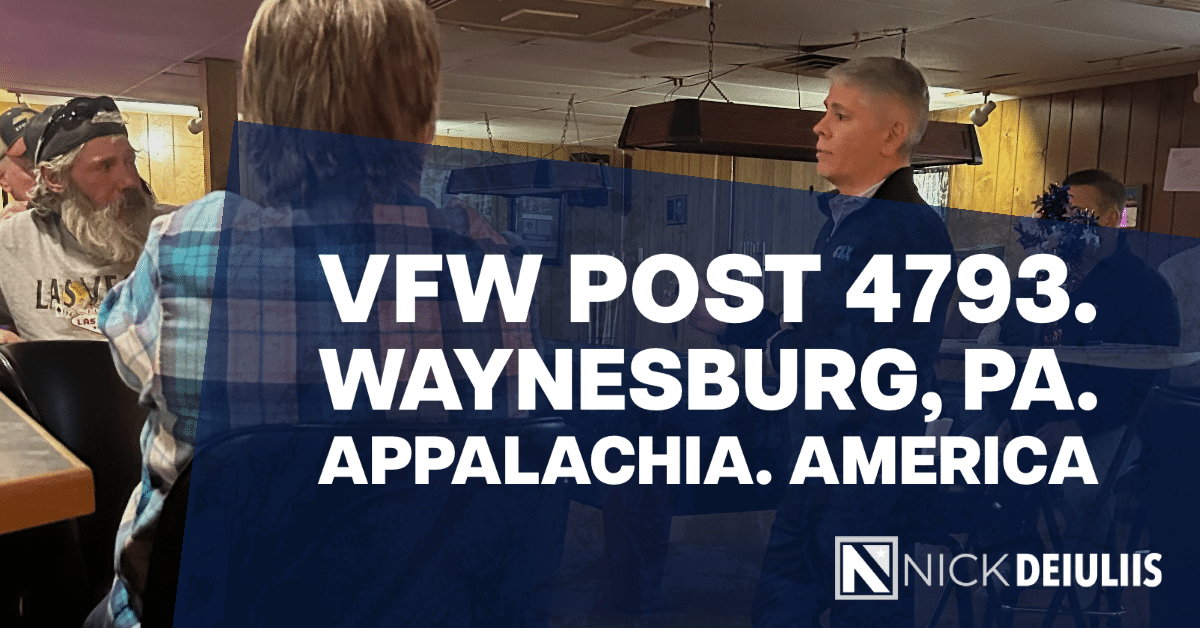
On Wednesday evening we headed down to Waynesburg, to the Veterans of Foreign War (VFW) Post 4793. We stopped in to say hi to some of our neighbors, fellow domestic energy workers, friends, and coworkers. To find another way to have the CNX Foundation and Appalachia First come alive. And to do it on Vietnam Veterans Day.

Wednesday was the always popular wing night at Post 4793, which was filled with regular members, from families with small kids to old timers. So, we bought the wings for the night (food never fails to please). We raffled off four Penguins tickets. We ate wings and had a tap beverage or two. Talked some, listened more. Forgot to sign ‘the book.’ And promised we would be back.

March 29 at Waynesburg VFW Post 4793 marked the start of something new at CNX and for the CNX Foundation. We are all in with supporting this region’s veterans through the VFWs and American Legions spread across the communities where we operate and live: western Pennsylvania, eastern Ohio, West Virginia, and western Virginia.

See you soon, veterans. On taco Tuesdays or wing night. At events to honor a recently departed member. To say hi and…thank you.

Waynesburg and its vets are the epitome of western Pennsylvania. And western Pennsylvania is the heart of Appalachia. And Appalachia is the soul of America.

Talking Energy, Region, and Careers at the Rock: Another Best Day Ever

The summary below follows Nick Deiuliis’ March 2, 2023, presentation to Slippery Rock University students and faculty.

Life in the digital age leaves much to be desired, but occasionally offers serendipitous moments. An unexpected opportunity pops up and turns out to be engaging.

I received a message on LinkedIn from an undergraduate student in petroleum engineering at Slippery Rock University who recently took on the role of chapter president for the Society of Petroleum Engineers (SPE).

He introduced himself and asked if I would be willing to come speak to the SPE chapter.

That’s impressive initiative that deserved an affirmative answer.

Shared Appalachian Connections

And with so much shared history, how could I resist such a request?

Slippery Rock University traces its western Pennsylvania roots back to 1889, which is a few decades after the founding of the company I work for, CNX Resources, in Appalachia. Both share a history and are long time regional leaders of western Pennsylvania and Appalachia.

The request was a chance to spend time with engineering, physics, chemistry, and safety management students. Disciplines I’ve had the pleasure of toiling in, working with, and proudly associating with for decades. My kind of crowd.

There are zero degrees of separation between company and university. The employee ranks of CNX are filled with Slippery Rock alums. From a vice president (who pressed me to remind the audience of his gridiron glory) to an intern who recently became a full-time engineer (who clearly had a more popular following by students and faculty than our vice president).

I never want to turn down a chance to hear from and fire up the next generation of Appalachia, the domestic energy sector, and the manufacturing industry. Making sure every student knew the massive career opportunity set waiting for them. Letting them know they indeed have what it takes to succeed in their craft. And listening to gage where their heads are in an increasingly chaotic world.

I always welcome opportunities to unabashedly promote Appalachia, western Pennsylvania, domestic energy, CNX Resources, and Slippery Rock University. An economic and social ecosystem where it’s all for one and one for all.

The visit also served an opportunity to recruit. Not just for CNX Resources, but on behalf of all the fabulous partners we work with in the energy industry and within Appalachia. I hoped to return from Slippery Rock with a roster of connections and a stack of resumes. Mission accomplished.

CNX embraces its Appalachia First vision for the region, and it doesn’t get more Appalachia First than this.

Let’s Talk…

Slippery Rock offers a strong array of STEM-centric majors: physical sciences, engineering, and safety management to name a few. Students and faculty convened in the Vincent Science Center auditorium and we got right into it.

The Vincent Science Center is home to the Physics and Engineering Department at Slippery Rock University.

We covered the potential of the Appalachian basin, recognizing it is the second-largest natural gas field on the planet when you combine the Marcellus and Utica shale horizons. Natural gas is not a bridge fuel, but instead a catalyst fuel for the future.

We discussed the need for resilient businesses to secure competitive moats within their industry and market.

To illustrate, I explained how CNX Resources enjoys three moats of resilient, competitive advantage: stacked pay acreage of Marcellus and Utica shales, vertically integrated assets of upstream production wells and midstream pipelines, and an avenue of new growth offered by the development and commercialization of new technologies to provide future energy solutions.

We dove deep into culture and values of organizations.

By example, CNX embodies the three core values of responsibility, ownership, and excellence. We might invest time defining them with words for a website or brochure, but in the end the values will be understood and evident by seeing them come alive in the decision making throughout the organization. From the newest employee to the CEO; from the smallest to the largest decisions.

Values and culture are crucial filters when making decisions in the real world. If you see the culture/value ‘talk’ not aligning with the ‘walk,’ there is a problem. When encountering such a conflict, always look to the ‘walk’ for the true culture/values.

We also addressed timely topics one hears about everywhere these days, but topics that are typically not subjected to sufficiently rigorous thought. I referenced such topics as a select grouping of popular ‘urban legends’ in energy and business.

At the front of the group was ESG investing; how it is labeled as a cure-all remedy and the inevitable future of investing. But reality has exposed a stratified layer of good, bad, and ugly applications of ESG.

Of course, climate change was included in the agenda. The certainty of rising atmospheric CO2 levels from human activity. But the far from certain and hopelessly inaccurate climate models when it comes to predicting the impact of CO2 on past, present, and future climate.

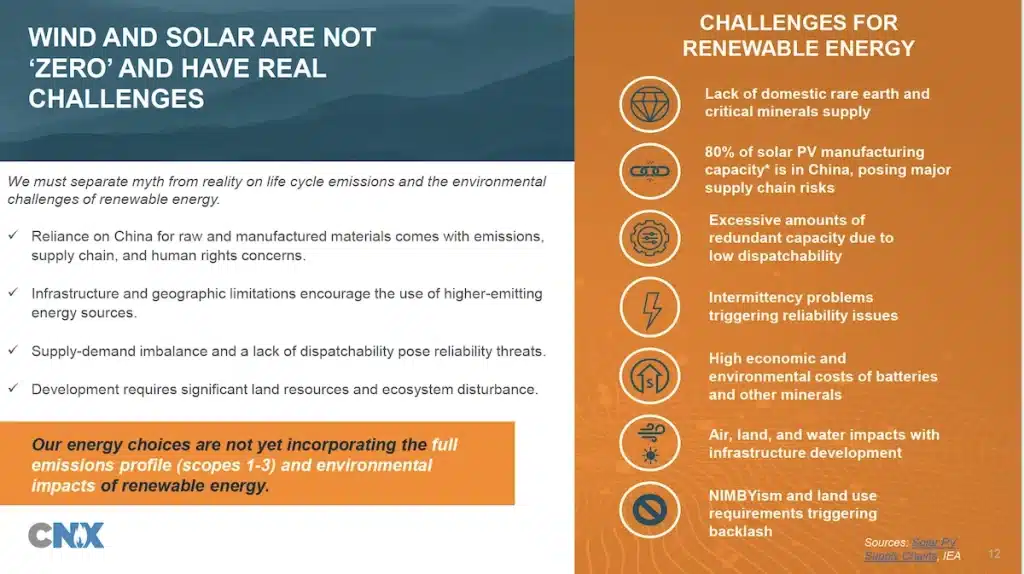
Is there a bigger urban legend these days than the myth of zero carbon/emission-free wind and solar?

We walked through the complex, murky, and often ugly supply chain of producing an intermittent kWh of electricity in Pennsylvania from wind or solar. And what happens to stakeholders along that supply chain: from child workers in Africa, to slave laborers in Xinjiang, to ruined ecosystems in the developing world, to stressed and unreliable grids in America and Europe, to the regressively taxed middle-class ratepayers.

Climate policies that protect, subsidize, and mandate wind and solar are stacking up a resume of failure across global grids. Power grids in the EU, UK, California, Texas, and here in Pennsylvania (PJM nearly broke during this past Christmas Eve cold snap) have all stressed or broke at the worst possible times due to the consequences of a mandated energy transition that was not well thought out.

Wind and solar, along with EVs, comprise quite the sustainability horror story. Worse yet, their life cycle carbon footprints are far from zero, and likely grossly exceed the life cycle carbon footprints of domestic energy sources such as power generation fueled by regional natural gas. It’s simply a matter of performing a basic carbon mass balance across supply chains.

The geopolitical implications of energy policy were not left out of the conversation.

Climate policies that mandate wind and solar are de facto projections of geopolitical power for China, the primary American adversary today, who enjoys dominant control of the supply chains for wind, solar, and EVs. Conversely, allowing domestic energy to ‘do its thing’ in the competitive free market serves as a projection of American power as effective as military might.

The expert class shouts endlessly about a Code Red for humanity as it relates to climate change. But the real Code Red for humanity pertains not to climate change, but instead to climate change policies.

Wanting to believe wind, solar, and EVs are zero carbon and sustainable is blind ideology bordering on religion. Daring to know the harsh reality is true to the scientific method and is faithful to rational thought.

Thymos: Propellant of Futures and Careers

Toward the end, things turned a bit philosophical. The Greeks introduced the concept of thymos, an individual’s drive to be recognized and to achieve.

Different people exude different levels of thymos. Same with teams, companies, and groups. Students need to assess where they sit on the thymos meter, and then seek out a culture and team that matches their personal level.

There is no right or wrong level of thymos. But a mismatch between the individual’s and organization’s thymos level will result in a bad fit. Recognize the importance of inner thymos, assess how it lines up with that of the team, and career choices become clearer.

A great proxy for high levels of thymos is a preference for in-person work over remote work. That’s true for individuals as well as companies. With the availability of remote work in a post-pandemic world, young professionals have a useful gage for matching thymos levels. If one is high-thymos, they may struggle on a team that embraces a remote work environment.

The conversation wrapped on the topics of advocacy and duty. It used to be that a professional could keep one’s head down and ignore the discourse of debate. Not so today. STEM professionals share a duty, morally and ethically, to advocate with fact and science. And to do so civilly.

That’s why I answered the call for Slippery Rock. And why I plan on coming back.

Crunching the Numbers: Energy Source Externality Accounting

Nick’s discussion and commentary below follows an inquiry from an academic team conducting research on externality costs. The inquiry asked to identify peer companies that either externalize the smallest or largest proportion of their costs. Externalities were defined as, “costs incurred by third parties, such as local communities, due to a company’s business operations that are not borne by the company itself.”

In his response to the inquiry, Nick suggests externality accounting is first performed across different sources of energy and power generation prior to assessing peers or competitors within a specific type of energy. Nick subsequently compares the externality costs between the natural gas industry versus the wind and solar industries.

Properly Sequencing Externality Accounting

Externality accounting is a useful tool when applied objectively, but one that is often misapplied and mishandled by those looking to dial in desired outcomes. Many fail to appreciate the sequencing of externality screening is crucially important when assessing entities across the energy industry.

Before assessing peers or competitors within a specific type of energy (such as natural gas), one should first apply externality accounting across the different sources of energy and power generation.

Thus, I propose a context of peer/competitor that is a level higher than, and a precursor to, what you proposed in your request.

The first cut of externalities should be done on an energy source-versus-energy source basis. In other words, domestic natural gas compared to wind or solar energy sources.

Society must screen options of energy sources within the wider portfolio first, and then set policy and investments to reflect the math of the externality accounting. First figure out the best energy source, as dictated by externality accounting.

After the first cut, or filtering, by energy source, one can then turn attention to different players within individual energy sources.

Getting the externality accounting/ranking for discrete energy sources (natural gas versus wind or solar) right is much more important than, and is a prerequisite to, screening or ranking individual players within an energy source (CNX Resources versus our natural gas competitors).

Many, including those in academia and government, have failed miserably to perform the rudimentary externality accounting and ranking of different energy sources. That leads to wrong-headed energy and climate policies resulting in dire consequences seen everywhere these days. Conditions will only worsen until this failure is corrected.

So, for the purpose of your inquiry and the discussion that follows, I am the natural gas industry, not just a player within it. And my peers/competition are the wind and solar industries, not another peer in the natural gas industry.

CNX Resources

CNX Resources is not a typical public energy company. We occupy a unique space in both the industry and region we call home.

We are nearly 160 years old – Abe Lincoln was president when we were incorporated. We manufacture natural gas in the northern Appalachian basin (PA/OH/WV/VA). The Appalachian basin “accounts for nearly one-third of all U.S. dry natural gas production,” and looks to be the second largest natural gas field on the planet. We operate in the Marcellus and Utica shales, we collect coal mine methane, and we operate midstream pipeline and processing infrastructure.

At CNX, our sustainable business model is simple: Tangible, Impactful, and Local. We’ve embraced the role as a regional innovator driving Appalachia’s socio-economic revitalization through local talent, homegrown energy, and breakthrough technologies.

We don’t apologize for what we do for society, we proudly celebrate it.

If our industry were to disappear tomorrow, society would come to a complete halt and humans across the planet would suffer greatly. That might not be what the experts or the environmental movement warrant, but that is certainly the engineering reality.

CNX recently unveiled its Appalachia First vision, which lays out many of the key themes I discuss below. Please learn more about our vision at www.positiveenergyhub.com. The site includes an approximately 45-minute presentation where I further discuss Appalachia First, which can be best summed up as “produce it here, use it here, first.” I think you will appreciate some of the policy positions.

Natural Gas

There are a few, crucial scientific and engineering realities that are often ignored when assessing the externalities of domestic natural gas.

Natural gas is the most cost-effective form of energy in the United States, providing consumers, businesses, and homeowners savings in energy costs that total in the hundreds of billions of dollars annually. Rampant inflation has caught everyone’s attention these days; the most effective means to curtail general inflation is to simply allow natural gas to provide cheap energy so that energy inflation, and by extension general inflation, is mitigated.

Natural gas is the superior solution to immediate and material greenhouse gas emission reductions. Domestic natural gas has and can continue delivering these benefits while maintaining power grid reliability during the dark days of winter and dog days of summer.

Power grid reliability cannot be underscored enough. From college campuses to homes, from hospitals to emergency responders, and from government buildings to other businesses and facilities, America needs power all day and night, 24/7, 365 days/year.

Environmental Benefits of Natural Gas

Today, much attention is focused on methane emissions. Natural gas produced in Appalachia has the lowest methane intensity (0.09%) of all major U.S. oil and natural gas-producing basins, according to Clean Air Task Force data. Additionally, Rystad Energy analysis of CO2 intensity performance “brings Appalachia to the top quartile among all oil and gas fields globally” with the firm expecting the basin to “improve further in its CO2 intensity dimension in the next three to four years.”

When natural gas competes with alternative energy sources in a free market, emissions drop, and environmental quality improves. As natural gas-fired electric generation topped 40% of the total grid, power sector emissions dropped by nearly the same, per the U.S. EPA. “The decrease in coal-powered electricity generation and increase in natural gas and renewable energy electricity generation contributed to a decoupling of emissions trends from electric power generation trends over the recent time series,” the agency wrote in its April 2022 inventory.

Consider the specific example of the PJM power grid. Power sector emissions declined 11% year-over-year as natural gas grew to 44% of PJM’s total capacity. And, Pennsylvania had the highest absolute decline of energy-related CO2 emissions of any state between 1990 and 2018, with emissions falling as natural gas became the state’s largest electricity source. The data and facts are unequivocal, yet rarely heard.

Economic Benefits of Natural Gas

The environmental gains tied to natural gas come with additional economic and job creation benefits.

Natural gas development across Appalachia has breathed new life into forgotten Rust Belt communities and brought the building trades and apprentice programs to full employment.

Careers paying family-sustaining wages offer on-ramps to the middle class for young adults in urban and rural communities who are not able or wanting to attend college. Manufacturing, which relies on reliable and cheap energy inputs, is experiencing a resurgence across Appalachia and the Midwest, creating a downstream benefit to the natural gas industry. These create huge, positive externalities.

Investment and growth in the natural gas industry grows tax base for governments and communities. Today governments are desperate for sustainable endeavors and economic sectors that pay their fair share of tax. You won’t find another industry in Appalachia that pays more of a fair share of tax than the natural gas industry.

And natural gas is the catalyst that accelerates and de-risks the integration of next-generation technologies, such as hydrogen, into our economy. That creates optionality for innovation, a serious and positive contributor to the externality math.

Bottom line: there’s never been a better climate jobs program than the shale gas revolution. Performing an objective and clinical externality accounting would prove it.

Intermittent Wind and Solar Energy Sources

Now, let’s discuss the externalities of wind and solar.

The most fundamental misunderstanding about wind and solar is the myth that they present a zero carbon footprint. That is simply not true, not by a long shot.

Carbon footprint must be assessed on a life cycle, scopes 1-3, basis. It doesn’t matter to the atmosphere where the CO2 is emitted in the life cycle of making and running a wind turbine or solar panel; just because there is not a significant emission once in place does not mean there is a zero carbon footprint.

To accurately account for the carbon footprints of wind and solar, the supply chain of how wind and solar power ‘happen’ must be traced:

  • First, massive environmentally destructive mining must occur in Russia, China, and Africa for the metals and materials comprising wind turbines and solar panels. That presents a huge carbon footprint and large CO2 emissions.
  • The raw mining products must be processed to purify them, which also requires huge inputs of carbon power and the associated CO2 emissions.
  • Then components need manufactured in factories, often in China, that are carbon-powered.
  • Manufactured components are then shipped thousands of miles on carbon-fueled planes, trains, ships, and trucks to arrive in places like America.
  • Trees and land must be cleared to site pads and concrete will be used to build the pads for the turbines and panels, emitting more carbon dioxide.
  • New transmission lines must be run to every wind turbine and solar panel block/array, requiring the felling of more trees to create the rights-of-way and the manufacturing of the new power lines, adding to the CO2 emission tally.
  • Backup and reliable sources of generation will be required for when the sun isn’t shining or the wind isn’t blowing, which will typically be carbon-based power generation (often coal) creating more carbon dioxide emissions.
    • There is no such thing as a wind- and solar-only grid, because both sources of electricity are intermittent (battery storage cannot be scaled to serve as backup and it has a carbon footprint worse than wind and solar).
    • It’s also worth noting the double-building and maintenance of power generation units increases costs to consumers.
  • In seven to 10 years, you need to perform this process all over again, because the turbines become obsolete and must be scrapped (there is no way to recycle wind turbine blades) and solar panel efficiency declines year after year. The repeat of the cycle doubles the carbon footprint.

There is also the impact on surface land that wind and solar have to add to the externality analysis. For a 100% wind- and solar-powered U.S. grid, wind and solar farms would have to occupy 300 million additional acres of land beyond what’s used to power our economy today. That’s building solar and wind farms across land areas equivalent to Arkansas, Iowa, Kansas, Missouri, Nebraska, and Oklahoma, according to Bloomberg analysis of Princeton data. A ridiculous non-starter of course, yet no one seems to acknowledge it as such.

Negative externalities exist with the aforementioned disposal of turbines and panels beyond their useful lives. Wind turbines can’t be recycled and are “piling up” in landfills, according to Bloomberg. Solar panels contain hazardous materials which must be disposed of properly or risk environmental damage; most environmentalists would consider it hazardous waste (until you told them it was from solar).

Today, consumers want their eggs to come from cage free chickens, their tuna to be caught with dolphin friendly nets, their straws to be biodegradable, their detergents to not use chemicals harmful to water ecosystems, and their jewelry to have gems that are conflict-free.

Yet there is not a home in America today with rooftop solar that can say with certainty those panels were not partially manufactured by either child- or slave-labor. The human rights abuses tied to the murky global supply chains of wind and solar are egregious. Yesterday we were concerned about blood diamonds; today the concern should be about blood solar. The externality cost of human rights abuses in the manufacturing of wind and solar is sobering.

And there is no wind turbine in America today that can warrant it does not kill scores of birds and bats, many of them endangered. Offshore wind farms near New York and New Jersey are being constructed in the middle of endangered whale habitat, and, wouldn’t you know it, but dead whales are now washing up on beaches in New Jersey and New York. Yesterday we were worried about saving the whales and the bald eagle; today the worry should be how wind turbines lay waste to whales and eagles. Energy production that proves deadly to sensitive species and habitats should be reflected in an externality analysis.

Wind and solar require tax subsidy that exceeds total subsidy of natural gas, coal, or oil by orders of magnitude. When you add up the various programs and subsidies to favor wind and solar, the tally will register in the hundreds of billions of dollars (or perhaps even in the trillions of dollars), depending on what time frame you choose. Those valuable dollars could be invested elsewhere and should be added as an externality cost.

There are serious geopolitical externality costs tied to wind and solar. China’s control of the solar panel supply chain has ballooned to 84% over the past decade, with the country also controlling the bulk of critical minerals production and processing necessary for battery storage. This is a critical risk that presents energy security, supply chain, and national security concerns that manifest as negative externalities.

Wind and solar aren’t keeping pace with global energy demand, falling 165 exajoules short of needed capacity, according to the 2022 BP Statistical Review of World Energy. Growing global energy demand requires massive scale that cannot be met with wind and solar under the laws of physics.

When wind and solar inevitably fail to deliver at scale due to their engineering realities, energy security in places like Europe necessarily falls back to carbon-based fuels from places like Russia. That emboldens despots to use the gifted energy leverage to warmonger, as in the case of Ukraine. Climate policies and the resulting flawed reliance on wind and solar are the root causes of the war in Ukraine. The policies created a de facto EU reliance on Russian energy. What’s the externality cost of Russia in the Ukraine? Whatever it is, add it to the negative externality tally for wind and solar.

Add it Up

Tabulating the externality impacts of energy provided through natural gas and comparing it to those for wind and solar will present a trio of decisive and obvious conclusions:

  1. All economic activity and forms of energy have carbon footprints; there is no such thing as truly zero carbon power or a zero carbon economy.
  2. Natural gas offers the best net externality balance within an energy portfolio. Its externality benefits are substantial and diverse while its externality costs are modest.
  3. Wind and solar present a massively negative net externality cost to society, particularly when the attempt is to deploy them at scale.

These three conclusions are opposite of what is warranted by the environmental movement, and many in government and academia. Climate and energy policies are set that ignore the math. We share a duty to correct that.

Further readings
U.S. natural gas production set a new record in 2021
https://www.eia.gov/todayinenergy/detail.php?id=54200
Benchmarking Methane and Other GHG Emissions of Oil & Natural Gas Production in the United States https://www.catf.us/resource/benchmarking-methane-emissions/
“International analysis finds Marcellus best in carbon dioxide intensity”
https://www.bizjournals.com/pittsburgh/news/2021/04/23/rystad-energy-international-analysis.html
Inventory of U.S. Greenhouse Gas Emissions and Sinks: 1990-2020
https://www.epa.gov/system/files/documents/2022-04/us-ghg-inventory-1990-2020-data-highlights.pdf
China’s Greenhouse Gas Emissions Exceed Those of All Other Developed Countries Combined
https://www.scientificamerican.com/article/chinas-greenhouse-gas-emissions-exceed-those-of-all-other-developed-countries-combined/
Net-Zero America: Potential Pathways, Infrastructure, and Impacts
https://netzeroamerica.princeton.edu/the-report
Wind Turbine Blades Can’t Be Recycled, So They’re Piling Up in Landfills
https://www.bloomberg.com/news/features/2020-02-05/wind-turbine-blades-can-t-be-recycled-so-they-re-piling-up-in-landfills#xj4y7vzkg
Statistical Review of World Energy
https://www.bp.com/en/global/corporate/energy-economics/statistical-review-of-world-energy.html

The West and China: A Rabbit That Has Been Hypnotized by a Snake

Twain famously observed how history doesn’t repeat, but that it tends to rhyme.  America and the West learned a hard lesson during the Cold War when the preeminent communist power of the day attempted to sedate the free world into a geopolitical slumber using an ingenious approach.

Today, we are making an uncannily similar mistake, this time with the modern-day communist power of China. If we don’t heed the historical rhyming and lessons that come with it, troubled times are certain.

The 1950s and the Geopolitical Sedative of ‘Peaceful Coexistence’

In early 1956 Soviet ruler Nikita Khrushchev delivered a secret speech to the Twentieth Party Congress.  In it he unveiled the new official state policy of ‘peaceful coexistence,’ which the Soviet Union would apply when dealing with its rival, the West.

Peaceful coexistence was packaged to be appealing to western Europe and the United States.  The concept advertised a future where communist nations in the Soviet sphere could live alongside western democracies, without fear of constant strife and with an eye toward reducing tensions.

Of course, the Soviet Union’s and Khrushchev’s true intentions with the application of peaceful coexistence were quite different than what was promoted to the West.  Behind the rhetoric of détente sat the long-term twin objectives of lulling the West into a false sense of security and of laying the groundwork to decisively vanquish democracy.  Peaceful coexistence was in many ways a marketing campaign to produce the opposite result of its name.

The Soviet propaganda machine got fully behind the promotion of peaceful coexistence.

Countless influential individuals in the West, including the powerful in European and American governments, took the bait hook, line, and sinker.   Peaceful coexistence was quickly embraced by the elite and expert classes.

The few who early on saw peaceful coexistence as a sham were initially labeled as narrow-minded and backward thinking.  Until the Soviets brutally invaded Hungary later in 1956.  Russian tanks in the streets of Budapest immediately clarified that peaceful coexistence was nothing but a ruse to buy time, gain advantage, and outmaneuver the West.

Peaceful Coexistence Redux: Modern China and the West

China has been promoting its own brand of peaceful coexistence for decades.  It is masterfully good at it; China today is much more persuasive, effective, and patient than the Soviets ever were in the 1950s.

China’s version of peaceful coexistence has successfully permeated just about every institutional pillar of modern western society.

Academia, having a seemingly incurable ideological soft spot for communism and its cousin socialism, needed little coaxing to jump on the peaceful coexistence bandwagon.  Colleges have been eagerly pocketing Chinese money to fund a broad spectrum of research and programs.  Universities compete to take on as many full-tuition-paying Chinese nationals as possible in undergraduate, graduate, and postdoctoral slots.  Individual professors, departments, and universities across higher education are hopelessly conflicted and financially indentured to China.

The capital markets have behaved badly under the influence of peaceful coexistence.  The largest investment houses, banks, and private equity firms assessed the growth prospects of China, and happily poured trillions of dollars into the communist economy.  Much of that economy is designed to pilfer technology from the West, further militarize the communist nation to better prepare for conflict with the West, and to build strategic industries that aim to destroy competition in the West. Ironically, the biggest capitalists in the free world have willingly funded a regime that exists to destroy capitalism.

Big business, specifically global corporations, saw over a billion potential new Chinese customers for products. They quickly became transfixed with peaceful coexistence, to where companies began acting illogically.

Major US airlines refuse to acknowledge the nation of Taiwan on their global maps resting in the seat pockets of their planes, for fear of upsetting China.

Tech firms grant Chinese state security access to user personal data that they would never dream of providing to US authorities.

Peaceful coexistence coupled with over a billion potential viewers have hypnotized western media and entertainment.  The Chinese Communist Party acts as director, editor, and producer of most major Hollywood films these days.  And marquee athletes and professional sports franchises are much more comfortable deriding their home nations and ticket-buying customers than they are speaking truth to the power that is China.

The western environmental movement fully embraced peaceful coexistence and commits the most egregious acts of aiding and abetting China.  Much of this knowing collusion falls under the flaw and folly of ‘tackling climate change.’

Environmentalism used anti-science ideology and nonsensical concepts of zero-carbon and renewable energy to drive policy mandates, subsidies, and protections for products with supply chains controlled by China.

Environmentalism is proving to be a geopolitical trump card for China:  eradicating American energy independence brought on by the shale revolution and replacing it with a certain energy dependence on China.

Politicians, not always the sturdiest of moral fortitude and discipline, were often easy marks for China’s brand of peaceful coexistence.  Outwitted and outmaneuvered presidents, popes, and climate czars engage China with visions of world peace/détente, new members of the religious flock, and climate accords.  These western leaders bring back nothing of substantive value from the negotiating table, yet they readily cede value on the most vital of issues.

The biggest error politicians and state bureaucrats make when dealing with China is assuming discrete issues can be segregated from China’s grand strategy residing under its umbrella of peaceful coexistence.  Our self-anointed climate czar pretends we can put fundamental differences aside in a winner-take-all competition, so that we can agree on setting targets for future atmospheric concentrations of carbon dioxide.  China sees that miscalculation and happily utilizes it to secure more advantage and advance its strategic objectives.  That gives Code Red a new meaning.

A Wake Up Call from Sun Tzu

Communism remains the gravest threat to individual rights and human quality of life.  It desires to destroy the free world, bring what is left into its orbit, and grow its power.  The approach attempting to achieve these aims is insidious and steadfast.  It follows the ancient strategic teachings of Sun Tzu and the principles of Choho No Jutsu.

There is no art higher than that of destroying the enemy’s resistance without a fight on the battlefield.

Subvert anything of value in the enemy’s country.  Implicate the emissaries of the major powers in criminal undertakings; undermine their position and destroy their reputation in other ways as well, and expose them to the public ridicule of their fellow citizens. 

Do not shun the aid of even the lowest and most despicable people. Disrupt the work of their government with every means you can.

Spread disunity and dispute among the citizens of the enemy’s country.  Turn the young against the old.  Use every means to destroy their arms, their supplies, and the discipline of the enemy’s forces. 

Debase the old traditions and accepted gods.  Be generous with promises and rewards to purchase intelligence and accomplices.  Send out your secret agents in all directions. Do not skimp with money or with promises, for they yield a high return.

Act with Moral Superiority to draw the trust of the enemy’s people, in this way you gain the enemy’s own people as an ally against him.

Does reading that send a chill down your spine?

Global leaders of the communist ideology do not intend compromise, reform, or peaceful coexistence.  That was the reality during the Cold War with the Soviets, and it remains the reality today with China.

China understands that the elite in the free world desperately want to believe communism desires compromise and reform.  That desperate want is our biggest weakness.

The phrase ‘a rabbit that has been hypnotized by a snake’ is taken from the memoirs of German World War II and Cold War legendary spy chief Reinhard Gehlen, The Service.

America Needs a Third Party

I’m a big believer in America; where it came from, what it stands for, and its future potential. The United States is far from perfect, in both its history and its present. Yet it still represents the best social, political, and economic system to respect and nurture the individual.

But most sense something is very wrong with where the nation is heading. Look around at our national political leaders from both parties of late, is the best we can do? America needs a course correction.

Drastic change is not needed. The nation should not radically tear itself down and then rebuild itself into something perceived to be better abstractly but likely will be much worse. Keep the Electoral College, don’t stack the Supreme Court, defend the Bill of Rights, and preserve the free market.

But our political system is in dire need of new blood. Two parties have enjoyed a stranglehold on governance for too long. Where they were once different shades of similar ideals, today the two parties have split orbits to where they represent extremes that cater to the minority fringes and leave little for the large middle.

The Primary Problem

Primaries are mostly to blame for the current polarization of the two-party power cartel. A moderate Democrat has no chance when running against a proud leftist in a primary. A traditional Republican today may be dead-on-arrival when going up against a hard-right opponent.

Although moderates typically represent the strongest candidates to win the general election, today’s leadership in the Democrat and Republican parties, coupled with the primary election process, tends to kill off moderates before the general election.

The opposing party funds this dynamic, making it worse. How many times in the past decade have we seen one party funding commercials for the other party’s most extreme candidate in the primary election? The hope, of course, is that the extremist wins the primary, which will make it easier for the opposing party’s extremist to win the general. Experience has shown the logic works.

The dynamic also creates a talent drain in candidates. Many moderates with distinguished careers in politics have decided to step down rather than face a primary drubbing. Too many high-potential candidates never start political careers because of the radicalization of the primary party process.

People used to say to run for office you have to be nuts. Today, to successfully run for office you must be nuts, and extreme in ideology.

The General Conundrum

When candidates representing the extremes of each party prevail in the primaries, the choices in the general election leave much to be desired for moderate voters. If a moderate wants their vote to count and voice heard, they must choose the lesser of two perceived evils.

That gives an advantage to the leftist Democrat candidate in the general election. The leftist promises the world to voters and lavishes special interests with handouts, from universal income to college loan forgiveness. It’s hard to run against candidates who act as a political Santa Claus, where every day is Christmas, and the credit card bill never comes due.

To vanquish such an opponent, one needs sound ideas and a sensible platform that appeal to run-of-the-mill Americans. That hasn’t exactly been the descriptor of many Republican candidates these days, who obsess on their own form of cultural control, just from a different direction than their leftist opponents.

Between primary and general elections, moderate voters are bombarded with shrill messages from each extreme side. Messages get amplified beyond the campaigns, because each end of the spectrum enjoys its own major media outlets who are more than happy to stoke the partisan flames.

The moderate voter sees two options as election day approaches: someone whose extreme leftist views disturb but who offers the voter free stuff, and someone else whose extreme hard-right views frighten and who offers no free stuff. The exhausted moderate often ends up voting for the former, or perhaps simply staying at home and not voting at all.

The Remedy

The fix to our current political conundrum is surprisingly simple. What we need today is a third national political party. One where the Constitution is respected, individual rights reign supreme, government is minimal but covers its necessary responsibilities, the free market is unshackled, and fiscal discipline is exercised.

That description fits neither the Democrat nor Republican platforms of today. And these two parties have enjoyed a stranglehold on the presidency since 1852. Perhaps it is time to shake things up and fill the great middle void space that many Americans associate with.

Choice is good. Three options at the ballot box are better than only two. Particularly when the current two have radically evolved to the extremes.
The best fit for a third choice is libertarian. There are two classic strains of libertarianism.

The first is the purer and more extreme, the Ayn Rand view. Where all government intervention is a form of coercion, coercion of the individual is immoral, and thus government tends to be immoral. Government is not to be minimalized as much as it is to be eradicated. Government should not prevent or subdue individual choice, even if such choice might infringe on the rights of others.

The second strain of libertarianism is more practical, the Milton Friedman view.[1] Where government should still be minimized to maximize freedom of the individual to choose, but where government protects the ability of others to do the same. Individual choice remains paramount, but it must not infringe on the rights of others to follow their own values.

This second strain of libertarianism, when properly framed, would be attractive to many moderate voters today. Government out of our bedrooms and classrooms, the state spending only what it takes in, the shrinking of the Orwellian administrative state, releasing the Darwinian free market, and protecting individual rights and the Constitution.

A smaller, more nimble government focuses on the bare necessities of national defense, protecting rule of law and property rights, and preventing the infringement of individual rights. Taxpayers realize an honest-to-goodness rate of return on their investment.

Reversing the Slide

A third political party embracing a practical libertarian ideology would be an instant success in America. It’s not a break from western republican democracy, it’s a restatement of it. Many Americans would listen to the platform and rightly think, “well, yeah, isn’t that the way it’s supposed to be?”

Perhaps the biggest benefit to this third, new political party would be the inevitable moderation of the Democratic and Republican parties. The middle, a voiceless space today, would become relevant once again and demand that the extremes evolve toward the moderate middle or face the consequence of losing power.

A third party occupying the middle and embracing practical libertarianism would reform the primary election process without tearing it down. The leftist would struggle to make it through a Democratic primary. The hard-right nationalist is placed on the eccentric fringe of the Republican party.

Reasonable and compelling candidates organically sprout up from Republican and Democratic primaries. Coupled with the libertarian choice, citizens and taxpayers are in a better place no matter who prevails in the general election.

Cartels and Their Vacuums

Imagine if consumers had only two cola drinks to choose from, call them P and C. Over time, each option evolved to an opposite extreme. Brand P became laced with cocaine and extremely unhealthy, and brand C removed all sugar and caffeine to where it became nothing but tasteless, colored water.

If those two choices held cartel power and were protected from competition, no other product options would manifest. Many consumers would stop drinking cola beverages. If a new option was introduced with the features of what coal drinks used to offer, it would become an immediate commercial success.

Nature abhors a vacuum. But American politics have created an impressive vacuum and preserved it for too long. That’s to be expected with concentrated cartels, in business and politics. Time to break the cartel and create more choice.

President Biden recently bragged, “Milton Friedman isn’t running the show anymore.” So true, no matter if Democrats or Republicans hold power. And so sad, because if Milton Friedman’s libertarian views were running the show today, America would be in much better shape.

Few of us desire to practice politics. But all of us want to choose from the very best of options when it comes to selecting our political leaders. That’s what the Founding Fathers envisioned and that’s what we deserve.

Let’s get what we deserve.

1. Watch the video TAKE IT TO THE LIMITS: Milton Friedman on Libertarianism on YouTube to hear an explanation of ‘consequentialist’ libertarianism from Milton Friedman.