Heed the Historical Rhyming of Ludwig von Mises’ Omnipotent Government

Ludwig von Mises was a shining light in the Austrian school of economics and for libertarianism. Despite the obsession Keynesians and socialists have with tarnishing his legacy, Mises sounded the alarm about statism louder and clearer than anyone.
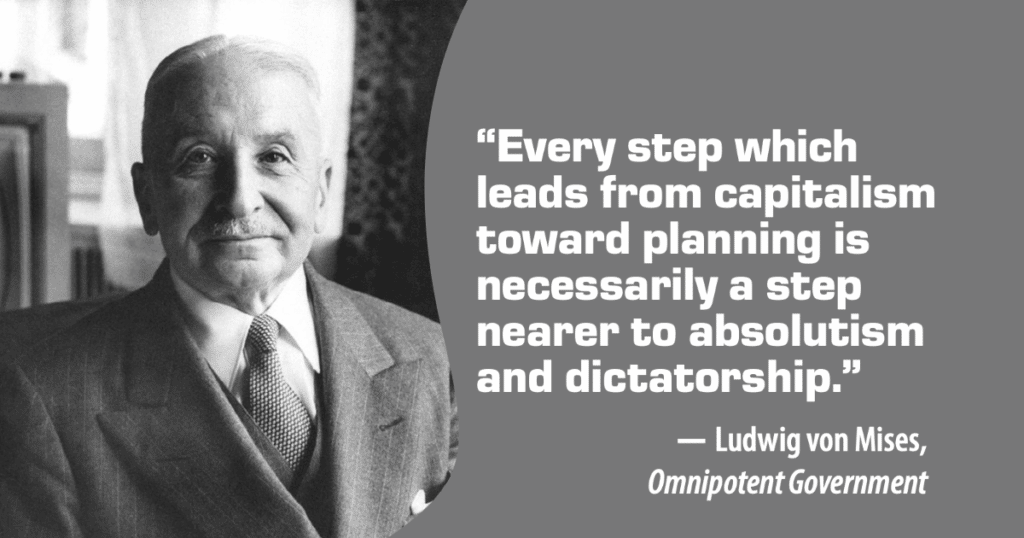
One of his great works was Omnipotent Government, which Mises published toward the end of World War II. Although much of the book focuses on analyzing fascism and socialism, many of the book’s insights from the mid-1940s are quite pertinent today.

Capitalism versus Totalitarianism

There are two big, opposite ideological trends for mankind to choose from.

The first is capitalism, which embraces freedom, rights of man, self-determination, and technology. Under capitalism the arts and science thrive. Excellence and meritocracy are celebrated.

The second is totalitarianism, where the state is omnipotent. Power is vested in government because government promises to make paradise.  Individual happiness becomes the duty of government, creating a nanny-state. The final goal is not a national government but a universal government.

Mises understood human nature comes with a certain level of intolerance of criticism of an individual’s social and economic beliefs. Often the intolerance is accompanied with labeling the critics as enemies of the nation, race, or group.

Capitalism has a clearly superior record compared to socialism and communism.  Thus, the supporters of the latter take pains to slander the former. Mises set the facts straight when it comes to capitalism’s superiority over socialism and communism.

Yes, capitalists and inventors get rich, but they do so while everyone else becomes better off with their inventions and products.  Capitalism is far from perfect, but in the long run raises quality of life for all, including the poor. Despite government continually attempting to stifle it. True liberals oppose state impediments to a free economy and freedom of economic activity.

Such benefits are not found with the bureaucrat or state control of the economy. Communism did not bring technological innovation to society and only copied the innovations of the capitalists. Only a bureaucrat can think that adding more bureaucrats, regulations, or impediments can be positive and beneficial. And the justifications will be in the name of progress and freedom, with both being the first casualties.

The concept of pervasive, omnipotent government did not start with the commoners and bubble up to the elite. Quite the contrary. Statism was conceptualized by the elite. All socialist thought was hatched by the 1%.

Totalitarians, whether socialist, religious, fascist, or communist, believe they are smarter than the citizens. Extreme right meets extreme left, with no tolerance of dissent. Hitler got his orders from above; the religious leader is infallible; President Xi enjoys demi-god status; and Putin is now leader for life instead of elected president for term. The German socialist Ferdinand Lassalle claimed, “the state is God,” which was eventually adopted as a slogan by the Nazis.

The Big Middle

But between capitalism and totalitarianism sits a wide spectrum of free market and government intervention mix. Etatism¹ is an economic system where the state owns and runs many things although some limited capitalism still exists.  Economic interventionism is the hallmark of etatism.

There is interference by restriction, where the state diverts production from channels demanded by the market, consumers, and technology into what the state desires.  Doing so makes people poorer, prevents individuals from achieving, erodes wealth, and wastefully expends funds.  Government ends up taxing losers and subsidizing winners, with inefficient bureaucracy in the middle of it all.

Interference by price controls is the second method of government interventionism, which sets values and prices differently than what the market sets them at.  Where market pricing sets equilibrium of supply and demand, government price controls create scarcity and rationing.

Mises found it ironic that the free market nations fighting Germany in World War II, the UK and US, were adopting a more etatist approach with a command economy.  In these once capitalistic economies, taxation was transformed into confiscation, free thinkers were taught to be thought followers, and individual freedom to act was supplanted with government now having the initiative.

In many ways, the creeping etatism of the Allied nations set the stage for World War II by creating international economic strains.  The UK wanted to protect its industry from France.  Belgians fought Dutch imports.  Subsidies for exports grew everywhere.  Protectionist tariffs spread virally.  Each nation was waging an economic war against other nations.  Everyone wanted free trade for everyone else and protectionist policies for their own nation.  Pain and tensions ratcheted up to the breaking point—and it feels like the same is happening today.

Mises knew that to address economic woes or preserve world peace, you don’t need another government office, bureaucrat, or global organization like the UN.
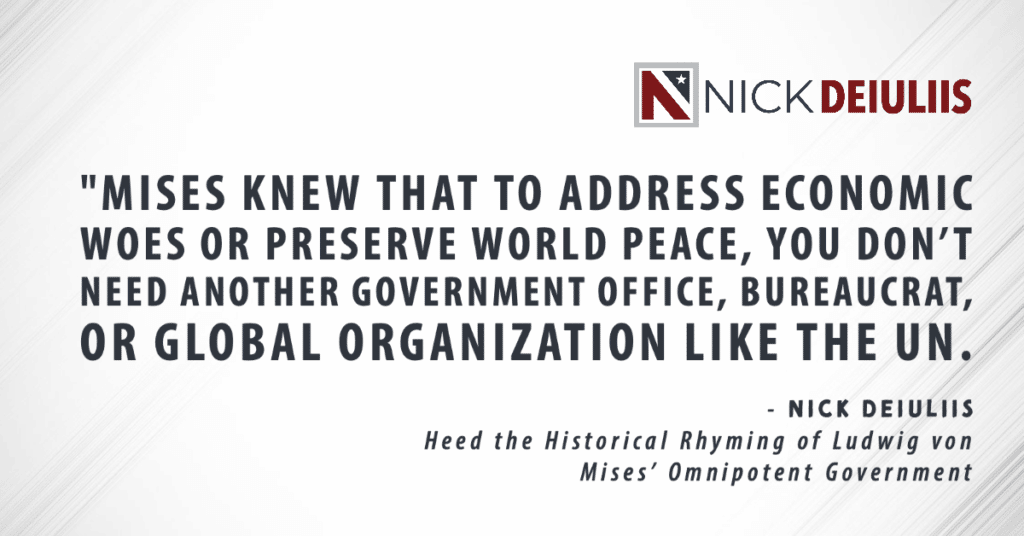
What is needed is stopping and rescinding domestic economic policies that substitute government for the private actor.

Unfortunately, we continue to drift to more etatism, with the growth of the administrative state to address inequality and the adoption of international accords like Paris to ‘combat’ climate change.

The evil genius of the transformation of western nations from free market to etatist is that when troubling symptoms of state control hit, such as inflation, unemployment, and economic inequality, people become convinced it is the fault of capitalism and not the fault of illiberal policies of government intervention. Academia and the bureaucratic state ridicule economic liberalism, the social sciences vilify the free market, university students are taught to admire socialists, and the entertainment industry has been promoting etatism in plays, writings, songs, and movies since the days of George Bernard Shaw.

The closer a nation orbits toward etatism and away from capitalism, the graver the danger. Mises said it best: “A state whose chiefs recognize but one rule, to do whatever at the moment seems expedient in their eyes, is a state without law. It does not make any difference whether or not these tyrants are benevolent.”

Although the state may end up doing and running lots of things, the essence of state action is always coercion and compulsion.  When done surgically and tactically, it works for the individual. But it should never be the ultimate. It is simply an instrument for the true ultimate: the individual.

The Weimer Republic and Today

Unfortunately, state economic intervention is popular as ever, including in the US.  FDR would be shocked to see how since the Great Depression, America blew past his New Deal incremental interventionist shifts and now sits closer than ever to socialism.  How did we get here?  Consider parallels to Germany just after World War I.

During the failed German Weimer Republic, businesses were accused of profiteering, inflation ruined the middle class, incompetent government looked to price controls, and a socialist approach was taken to monetary policy.  The media, economists, and politicians of the time ignored the danger of excessive monetary policy leading to commodity inflation. Capitalism was vilified as exploitive, unfair, warmongering, and benefitting only the 1%.

The answer was to increasingly manage business by government and the bureaucrat.  Easy money, price controls, wage floors, export subsidy, and import tariffs blossomed. All for the public good and to help the little guy.

Sound familiar?

Rise of the Nazis and Today

American popular support for socialism, communism, and state intervention have never been higher. We did not arrive at this point by accident, but under a methodical campaign waged by the elite over decades.

Much of the campaign’s playbook copied that of the Nazis in their rise to power before World War II. Nazism and German nationalism were first resisted by big business and the middle class. But these groups had no consistent ideology and were overcome by the academic focus of Nazism and nationalism. Youth came out of university indoctrinated to the cause.

The nationalists assumed key government posts. The economy became more etatist, which made businesses subserviate to the government and the bureaucrat’s nationalist ideology. The government ended up forcing business to bow to its views and fund those views.  Business had no way to influence public opinion once the tipping point was reached. The intellectuals beat the businessmen.

Substitute leftist/socialist for Nazi/nationalist, 2010-2020s for 1920-1930s, and America for Germany. Concerned?

Conclusion

The state has been an endless source of mischief and disaster through history.

Mises observed that “there is no more dangerous menace to civilization than a government of incompetent, corrupt, or vile men.” The minority in a society stands to lose and suffer the most as a state moves from capitalist end toward the etatist/totalitarian side of the spectrum.

That’s why I’ve always found libertarianism attractive.

Classic liberals and libertarians are not anarchists and do not desire to abolish the state. We want government to recognize the supremacy of the individual and to protect private property. If you have private property, then you have individual rights, and vice versa.

To avoid war, eliminate its causes, which are all too often nationalism and lack of free markets.  Make government small and focused on preserving life, health, and property. And safeguarding the free market.

Yet Mises’ writings convinced me that etatism is the natural tendency of bureaucrats and governments.  Only liberalism and capitalism prevail when pressed and forced by citizens. Market interventionism is a slippery slope that can quickly slide us toward totalitarianism.

Mark Twain noted that history does not repeat itself, but it often rhymes. Let’s hope the American experience in the coming years does not rhyme with Germany’s in the first half of the 20th century.

[1] Alberto Mingardi explains, “Mises uses ‘etatism’ instead of statism because that word, ‘derived from the French état… clearly expresses the fact that etatism did not originate in the Anglo Saxon countries, and has only lately got hold of the Anglo-Saxon mind.’”

Nick Deiuliis’ CNX Q2 2022 Earnings Call Remarks

The following is a summary of Nick Deiuliis’ introductory comments from CNX Resources’ Second Quarter 2022 Earnings Conference Call, held Thursday, July 28, 2022. Click here for more information.

Allow me to highlight three themes that are core to the CNX investment thesis:

  • First, we built and now manage a low-risk, $700 million per year free cash flow annuity that works year after year. This helps to largely insulate us from macro events out of our control, it creates confidence and conviction in our business, and it is sustainable and works in any environment.
  • Second, we then apply clinical math and, when the math dictates it, we allocate a significant portion of the free cash flow to reduce our share count at highly accretive rates of return, which will continue to deliver unprecedented free cash flow per share growth. That’s a tremendous opportunity for any value investor.
  • Third, and lastly, in addition to our organic free cash flow annuity and our growing free cash flow per share, we are creating, demonstrating, and deploying new technologies which will create incremental free cash flow and free cash flow per share beyond our base business and plan. The new technologies opportunities are here and now and offer a meaningful avenue for incremental per share value for our shareholders and for the next chapter of Appalachia’s energy legacy.

We are excited by the opportunities in front of us – they are impressive, outside-the-box, and unique to CNX.

So with that bigger picture in mind, let’s talk specifics.

During our first quarter call, we covered the destructive, yet predictable consequences of current national and global energy policies. These policies have, unfortunately, been extremely effective in manufacturing energy scarcity and stoking inflation by preventing the most sensible supplies of natural gas and oil from reaching demand centers and by relying too quickly on renewable energy not yet at scale. The consequences are higher energy prices, energy scarcity and inflation, economic turmoil, and geo-political instability, and they are becoming painfully clear to all.

This morning, I would like to build on this discussion and talk about what CNX is doing to improve the current situation.

Perhaps it goes without saying, but I will say it anyway:  CNX will continue to advocate for natural gas and the Appalachian region.  The standard of living we all enjoy is owed in large part to the great men and women doing the hard work to provide our energy, and we are proud to be a part of that.

Tangible Actions, Leading the Charge

At CNX we focus on near term, tangible actions rather than hypothesizing as to what may or may not occur decades into the future. Opportunities exist here and now to advance environmental and socio-economic goals, and we are proud to be leading that charge with recent announcements like our work with Pittsburgh International Airport and with Newlight Technologies.

We have been hard at work driving these and other key initiatives forward to advance our view of a legitimate and actionable sustainable energy revolution.  Improper planning and an inconsistent push toward the so-called energy transition, which is pinned to an irrational ideology that demands an immediate transition away from natural gas to renewable energy that will struggle to deliver at scale, is creating turmoil.  A realistic and achievable sustainable energy revolution demands a more thoughtful, common sense, practical approach.

That means creating fact-based solutions grounded in math and science today, not hypothesizing about potential solutions 20 or 30 years from now.  And by taking tangible steps to meaningfully reduce global carbon footprints in the most efficient manner.  Natural gas, Appalachia, and CNX must play a pivotal role in accelerating and enabling this progress.

Natural gas is not a bridge fuel.  I want to repeat that. Natural gas is not a bridge fuel. Instead, it is a catalyst fuel, which is the basis of the sustainable energy revolution by helping industries across sectors lower costs and emissions immediately.  It will also fast-track the implementation of new technologies. This will allow companies and industries to focus on driving efficiencies to eliminate waste, stop egregious labor and human rights practices, grow the value proposition for their ownership, and provide a viable path to achieve carbon reduction targets.

Look, the concept of solar and wind powering the quality of life to which we have become accustomed sounds fantastic in theory and is romantic as advertised.  But the ability of these technologies to satisfy the world’s energy needs is, to be kind, a highly questionable proposition.  One that is only practically achievable decades into the future and that is highly dependent on major advancements in technology and a massive increase in rare earth element and battery production capacity, an order of magnitude more than currently exists today.

For perspective, the world currently produces roughly 600 exajoules of energy annually, which includes approximately 39 exajoules from renewable energies related to wind, solar, and geothermal.  Said differently, only 6% of current energy production is derived from renewable energy despite decades of policy incentives and subsidies that cost nations, economies, and societies trillions of dollars. Twenty twenty-one was a record year for renewable energy installation, yet resulted in only 5 exajoules of renewable energy added to overall global energy production.

Now, on the consumption side, forecasts indicate that world energy demand will grow on average around 2% per year, which is approximately 10 to 12 exajoules per year.  Renewable energy is unable to keep pace with that type of global energy demand growth, let alone have the ability to displace fossil fuels any time soon.

During the last 20 years, world energy demand has grown by roughly 200 exajoules, and over the same time approximately 35 exajoules of renewable energy capacity has been added.  Renewables have a long way to go to simply meet new demand before they have any hope of displacing oil and coal in a meaningful way.  More low-cost and environmentally-friendly Appalachian natural gas can help meet this growing demand and make progress now on environmental goals.

Also, of the 600 exajoules of world energy production, fossil fuels account for over 490 exajoules of that total, with hydro accounting for 40, nuclear adding 25 more, and then the 39 EJ of wind/solar renewables to get to approximately 600.  A majority of fossil fuel production is oil and coal. Appalachian natural gas only accounts for approximately 12 exajoules, or roughly 2% of total global energy production, and represents the cleanest, lowest greenhouse gas intensive fossil fuel. Within Appalachia, CNX accounts for 0.5 exajoules and has the lowest GHG intensity and cost structure in the basin.

We Are the Solution

We, the Appalachian basin and CNX, are not the problem. Math and science show that we are the solution. CNX serves as a needed ally as the world seeks to reduce the other 490 exajoules of much higher GHG intensive fossil fuels and help keep pace with new energy demand.

There is also the issue of supply chain realities to consider.

CNX and Appalachia are closest to the major U.S. demand centers for energy, goods, and services, allowing our local energy to be even more greenhouse gas-efficient from an all-in, scopes 1-3, life cycle perspective.  Reducing unnecessary shipping logistics is the elephant in the room when it comes to emissions.

Investment in, and utilization of, our low-greenhouse-gas-intensive natural gas and its derivative products will rely on infrastructure that works with new green technologies when and if they are ready and able to be deployed to meet future demand.  This means that engines and factories can run off 100% compressed natural gas (CNG), 100% hydrogen, or related blends. The same logic applies to additional electric vehicle (EV) deployment, as natural gas turbines on the grid allow electrification to play a more meaningful role sooner.

CNX has been quite active making moves and investments with these broader policy realities in mind.

Our New Technologies team has numerous projects in various phases of development which will help the world move to a lower GHG emitting future, while also maintaining reliable energy resources for a properly functioning society.

The New Technologies team is commercializing technology that will produce low-carbon-footprint natural gas, derivative products, and associated environmental attributes.  These technologies are a game changer for the natural gas extraction and transportation industries.  Technology and assets from CNX can help displace higher carbon intensive fuels in the US energy mix, both on the power grid and in the transportation sector.

These displacement opportunities are over 100 billion cubic feet per day of natural gas opportunities in the U.S. alone.  More products and services could be produced within the Appalachian region.

Think of these emerging technologies to be commercialized falling into one of three major buckets.

The first bucket consists of what we designate as having valuable and monetizable environmental attributes.  We are capturing methane, through incremental capital investment and deployment of technology, which would have otherwise been vented into the atmosphere.   This ultra-low carbon gas is  increasingly valuable in a carbon constrained world.  Our Virginia assets are the foundational piece of that effort for CNX. Coalbed methane (CBM) is back in a big way, but in a much different world.  CBM today has a natural gas pricing base level of value, but also now enjoys an increasing portion of value tied to its ultra-low carbon characteristics.  Recognition of this value is growing across numerous economies.

The second bucket is proprietary technology we developed that will fundamentally change the manufacturing process for the extraction and delivery of natural gas.  The technology will transform drilling, completions, flow back, compression, processing, and so on.  It will make these processes more efficient, reduce risk, lower emissions, and increase margins.

The third bucket is using in-house proprietary technology to disrupt various industries currently relying on other less-efficient and higher-emitting forms of energy.  This technology efficiently transforms the state of natural gas from gaseous phase into CNG and LNG.  That CNG and liquefied natural gas (LNG) on pad can transform the aviation and ground transportation industries. Instead of off-shore, high carbon footprint, high-cost gasoline for ground transportation, the ability exists to use local, low carbon footprint, low-cost CNG.  It’s a similar story for aviation, with LNG replacing jet fuel.

The business case for this third bucket comes down to common sense.  If we want to lower global GHG emissions, you deploy new renewable energy in the sunniest and windiest places that still rely on coal and oil, to displace them.  You don’t place renewables at scale in places like Pennsylvania where the efficiencies are low, the costs at scale are high, the supply chains are thousands of miles in length, and the life cycle carbon footprints are going in the wrong direction.

What is better for the planet, for greenhouse gas emissions, for the regional economy, and for business models?  Making products overseas using coal fired power and inefficient power plants and factories, that utilize poor labor practices, and having all that wasted cost and energy transporting these products all the way to America? To sometimes work, depending on weather?  Or, simply manufacturing these products here with low carbon-footprint natural gas, more efficient power plants and factories, using local well-paid workers and shipping it within a one-day drive?  Pretty simple.

Focused on Innovation, Positioned for Success

Now let’s talk about tangible, impactful, and local recent results of the New Technologies team across these three buckets.  Our year so far has been full of accomplishment spanning all three.

A pathway for implementing our propriety technology to disrupt the old economy fuel supply mix is the announced partnership between CNX and the Pittsburgh International Airport. This is an exciting partnership for both parties.  CNX will help PIT lower their costs, reduce emissions, and create jobs by using low carbon intensity natural gas to displace traditional aviation and transportation fuels. This fits squarely in our Tangible, Impactful, Local mantra.

This partnership centers on how CNX has developed proprietary technology to cost-effectively convert on-site dry natural gas into LNG, CNG, and electricity for various uses including as a hydrogen feedstock.

These technologies reduce emissions and operating costs at the airport. This partnership opens a new frontier for using lower-cost, lower-carbon-intensity LNG and CNG fueling depots for higher energy intensive businesses such as airlines, transit, cargo, fleet, and related businesses. These natural gas derivative products will leverage our local community’s workforce and create more family-sustaining jobs.

We also recently announced another exciting partnership, between CNX and Newlight Technologies, to convert air and greenhouse gas into a biomaterial called Aircarbon.

Aircarbon is a carbon negative PHB biomaterial produced by naturally occurring microorganisms that replaces plastic in industrial segments ranging from food to fashion. Under the agreement, CNX and Newlight will work together to capture waste methane from third party industrial activity that would typically be vented to the atmosphere. CNX will capture, gather, and process captured methane to remove impurities, compress, and deliver the methane through new and existing natural gas pipeline infrastructure for conversion into Aircarbon by Newlight.

This strategic partnership, with CNX capturing methane gas to support Newlight’s manufacturing needs, is expected to result in several manufacturing facilities in the Appalachian region and advance critical decarbonization goals while boosting our region’s economic activity, capital investment, and job growth.

Beyond our New Technologies team, we believe the Appalachian region has the resources, know-how, and work ethic to be the epicenter of providing solutions to the challenges brought by poor energy policy and weakened geopolitical standing.

We can be a center for skilled labor job creation to help pave a path to middle class access for the region’s underserved rural and urban communities, and we put into effect a program to do just that.

This quarter, we graduated our inaugural class from the CNX Mentorship Academy, which consisted of 28 young men and women from this great region’s urban and rural communities. Six of these talented individuals recently joined our team at CNX; this is something our entire team and I are very proud of. We expect the second-year class to be even larger.  These young men and women will help us build our local energy ecosystem to cultivate and sustain the middle class for the next generation.

We also recently submitted comments to the U.S. Securities and Exchange Commission (SEC) regarding their proposed rules for climate disclosure. We are supportive of the SEC’s efforts but believe their proposed rules as drafted will create inconsistent and highly subjective standards for reporting Scopes 1, 2, and 3 carbon dioxide emissions across different industries and companies.

We believe in transparency and accuracy.

Our position is that the SEC should amend the rules to create greater standardization and clarity.  Fully transparent and honest accounting of carbon emissions will underscore the importance of natural gas as the pathway to a promising future.  We encourage you to read our letter to the SEC, which is posted to our website.

Conclusion

We believe that products and goods that we all use daily should be manufactured in Appalachia and first utilized in the U.S. to help our local citizens and economies. Similarly, let’s first focus on creating new and growing existing markets for our products regionally in Appalachia and nearby markets like the Northeast U.S. via short pipelines.  A local first mentality will go a long way to solving myriad problems across the socio-economic and environmental spectrum.  It’s not protectionism or anti-free trade.  Instead, it’s common sense, rational, and free market-based.

Tribute to the Church Fair

The dog days of summer: when July arrives, lawns turn brown, and shade is at a premium. When driving around western Pennsylvania during this time of year, every now and then I come across a neighborhood yard sign or occasional billboard in front of a house of worship promoting the upcoming church fair/carnival. Seeing these signs triggers two simultaneous reactions: the placing of a smile of nostalgia on my face, but also a tinge of melancholy in my mind. Both are for something once special that looks to be increasingly a thing of the past.

What used to be as commonplace as lightning bugs during the summers of my youth in these parts has become a bit of a rarity these days.

Few kids today experience what was once the exciting week when the carnival hit the local parish.  And a multi-year hiatus resulting from the lingering hangover of mandated pandemic shutdowns seems to have not just dealt a death blow to many church carnivals, but perhaps ultimately to many parishes themselves.

That is a shame, because the demise of the church fair mirrors in many ways the erosion of religion, values, and community in America.

Not long ago, church was culture.  Pittsburgh’s neighborhoods and surrounding environs were a mosaic of different ethnicities and creeds.  With each turn at a street corner or summiting of a hill in western Pennsylvania, you would navigate through Slovak, Polish, Italian, African American, Jewish, Greek, Lebanese, and countless other neighborhoods and cultures.  Western Pennsylvania, built by an immigrant class, was the textbook exemplar of a melting pot.

And with each distinct culture came a unique house of worship.  The bricks and mortar of that house became the physical and spiritual centers of gravity for the local community.  Everything revolved around it, including schools, sports, cultural events, and schedules. Infants were born in its shadow, kids were schooled in buildings attached to it, people were married in them, and the deceased were eulogized in services hosted by them.  The house of worship was a reliable provider for the members of the local community from cradle-to-grave, literally.

The celebratory event that brought everyone together once a year was the fair or carnival.

Kids would anxiously mark the week months in advance.  Families would plan vacations to not conflict with the fair.  Extended families would participate in home-away pairings, with cousins from different neighborhoods attending each other’s fairs as hosts/guests.  People took pride and held rivalries within extended families and across communities in the quality of the carnival at their house of worship.

Thus, people in these parts took their neighborhood church’s fair as a serious endeavor.

Resurrection Parish’s SummerFest 2022 (took place June 20-25).

You didn’t volunteer to lead the planning and organization of the carnival or fair; instead, you were selected by earning your way to the spot over years of competently rising through the hierarchy.  In many instances, sons and daughters performed the menial tasks within the team that their fathers and mothers did when they were younger.  Those at the top of the ladder usually were not there by accident.  Strangely, a nonprofit institution had a way of instilling a highly effective meritocracy when event reputation and money were on the line.

Perpetual Planning

Planning for the week of festivities was a perpetual process without end; as soon as the tents and rides were packed and shipped away, the leadership committee was off planning next year’s event.  That’s because the fair or carnival was a crucial piece of the financial viability of the church.  The proceeds funded the schools, paid for the capital improvements to the buildings, and underwrote many of the outreach programs for the local infirmed and poor.  With so much at stake, the house of worship applied a continuous improvement methodology that would rival the best practices found in the hospitality industry.  Overall event quality was the best guarantor of financial success.

Weather was an uncontrollable, yet critical, factor in the ultimate outcome of the year’s event.  A dry and rainless week virtually guaranteed a financial success, whereas dreaded rain would severely impair the financial proceeds.  The church fair taught you at a young age that events outside of your direct control could have an outsized impact on you and your tribe.  Weather was one of life’s ‘known-unknowns.’

Food: The Soul of the Fair

Every event was sure to offer the standards, such as hot dogs and pizza.  But then the ethnic nature of each church took over to offer custom items on the menu: pierogies at the Polish church, pastas at the Italian church, stuffed grape leaves at the Lebanese church, and so on.

Like those who planned, set up, and ran the event, the cooks and bakers for the fair were selected through merit; being a food contributor to the church carnival was a huge source of pride for the cook.  Some of the best food I ever had the pleasure of enjoying was at various Pittsburgh church fairs through the years.

The Ironic Reality of the Church Fair

The carnival taught every kid a new life skill:  how to gamble (and why you want to avoid it).  Games of chance were the biggest money maker for the event.  And the games were clinically designed to methodically procure income from young kids and adolescents.

Little kids would spend allowances saved up all summer to try to win that stuffed animal at the ring toss.  Teenagers would throw dollar bill-after-dollar bill earned from cutting lawns, babysitting, or delivering papers down on the table at the booth where the chuck-a-luck birdcages were rolling the dice.  Many young gamblers learned valuable lessons: the house always wins, you should quit when you are ahead (or not start at all), and the true meaning of ‘gambling is a regressive tax.’  The church had no problem profiting from its sin tax on the younger parishioners, and senior citizens parked at the bingo tables were also fair game.

The Rides

Most fairs had rides for the kids.  They were not amusement park-caliber rides, but they got the job done, especially for the youngest of attendees.  A little duct tape here and there, some leaking fluids at certain spots, and maybe not up to current day regulatory standards.  But the rides put a lot of smiles on little kids faces, and happy kids usually means happy parents, which leads to higher attendance and longer stays.

But That Was Then – Today is Different

Church fairs and carnivals are not as commonplace these days.  Heck, churches are not as commonplace or as well-attended.

I see those signs announcing the upcoming event and think back to my days of youth running around the streets of Pittsburgh and western Pennsylvania to all those different carnivals and churches.  I remember them all and miss them more than ever.

What do I remember? The best ride was the Ferris wheel at the St. Mary of the Mount fair on Grandview Avenue in Mount Washington, which offered a million-dollar view at night for a $0.50 ticket.  The most fun was at the Resurrection parish fair in Brookline, where my brother and I would be invited to attend with our cousins.  The best prize I ever secured was a glow-in-the-dark Star Wars movie poster, which adorned my bedroom wall for a couple of years.  The best food…is impossible to say, like picking a favorite child.  You love it/them all.

Long Live the Church Fair

Organized religions offer a mixed legacy, and many people are skeptical of them (author included). Yet this nation could regain much by refocusing on the values that the church fair and carnival epitomized.  Our local communities and national psyche need those values more than ever.


Eight Teachings for Business Leaders from the Battle of Midway

This June marks the 80th anniversary of the Battle of Midway—a battle that proved the turning point in the Pacific during World War II.  Over the past eight decades, historians have analyzed the decision making of the Japanese and American admirals while navies have studied the tactics of both carrier fleets. The consensus is that a few crucial decisions and a couple of vital hours in the four-day event swung the Pacific War’s momentum from Japan to the U.S., despite the Japanese enjoying superiority in carrier numbers and crew experience.

The Battle of Midway’s influence even impacted pop culture.  Hollywood produced two feature films depicting the events. The 1976 original boasts an all-star cast of Charlton Heston, Henry Fonda, Robert Mitchum, James Coburn, Glenn Ford, Pat Morita, Hal Holbrooke, Robert Wagner, and Eric Estrada (pre-CHIPs).  The 2019 remake, unfortunately, was more of an animated action video game than a film.

The Battle of Midway rightly captured the attention of those beyond war college instructors and military history academics.

Interestingly, one segment that may not have grasped the key takeaways of the battle is the business community. That’s a shame. Analyzing the Battle of Midway provides wisdom and insight for the modern business leader.

A closer look at Midway’s key teachings in the context of competitive commerce:

Midway Teaching #1: Sound Strategy is Required for Success, But Doesn’t Guarantee It

Japan’s Admiral Yamamoto took a broad, strategic view of the Pacific War.  Yamamoto knew Japan’s best chance at victory was to gain advantage over the U.S. Navy early and compel America to lose its desire to fight a protracted war across thousands of miles of ocean.  That strategy drove the planning for the Midway precursors—the surprise attack on Pearl Harbor and the Battle of the Coral Sea.

Yamamoto’s strategic vision also drove the planning for the Battle of Midway; he wanted to instigate a naval battle where the remaining U.S. aircraft carriers would be knocked out by the vaunted Kido Butai carrier fleet, hopefully resulting in the U.S. seeking peace or withdrawal from the western Pacific.  It was in many ways a perfect strategy.

Japan’s approach leading up to Midway provides two insights to business leaders.  First, strategy matters, and a rational, well-thought strategy should drive tactics.  Second, you may have a perfectly laid out strategy but fail miserably in the ultimate objective; good strategy is a prerequisite to success but does not guarantee it.

Both insights held true for Japan in the Battle of Midway and hold true in business.  Sound strategy is a must for business success, but it is far from a guarantee.

Teaching #2: Technology Can Both Eliminate and Provide “Edge”

Those familiar with the battle know the U.S. enjoyed advance warning of Japan’s target being Midway Atoll.  That’s because U.S. Navy cryptanalysts were breaking Japanese communication codes and knew weeks in advance that Japan was planning an attack in the Pacific, which the U.S. ultimately verified as Midway.  Admirals Nimitz and Spruance knew what the Imperial Navy planned before combat events unfolded.

Technology not only neutralized Japan’s strategic battle plans by eliminating the element of surprise, but it also flipped the advantage of surprise to the U.S.  The battle was not won solely by pilots and sailors in combat, but also by math majors working on codes at desks.

In business, technology can rapidly make the weak dominant and the strong obsolete. That holds true for companies, industries, and economies.  Taking the long view and investing the talent and resources into technology development and deployment can reap massive returns.

Just ask Amazon, Google, and Apple.  As well as their vanquished competitors such as Kmart, Lycos, and Blackberry.

Teaching #3: Disruptive Innovation Changes Outcomes

One of the American unsung heroes of the Battle of Midway is Lieutenant Commander John Thach, a fighter pilot behind the stick of a Grumman Wildcat.

Thach created and applied a new dogfight defensive technique, dubbed the Thach Weave. During the Battle of Midway the move proved highly effective against the until-then dominant Japanese Zero fighters.

The Thach Weave, which neither side’s commanders saw coming, had a multiplier effect on the battle’s outcome and reached far beyond the win-loss tally of Zeroes and Wildcats. It influenced precious timetables, the number of torpedo and dive bombers breaking through to attack carriers, and decision making.  Without the Thach Weave, the Battle of Midway may have ended with a very different outcome.

In business, disruptive innovation often appears unannounced and is the result of both trial and error as well as necessity.  One must be constantly on the lookout for its arrival as a potential threat that must be quickly acknowledged, and also willing to continually tinker under a sense of urgency to be the disruptor and innovator.

Teaching #4: “Target Fixation” Is a Killer

When the battle was still going relatively well for the Japanese, the Imperial Navy made a fatal error.  The Thach Weave not only proved highly effective in Wildcat dogfights with Zeroes, but it also allowed U.S. torpedo bombers to break through the initial Zero patrols to try to sink Japanese carriers.

The Japanese responded by committing all their patrolling fighters above the carrier fleet to engaging the U.S. Wildcats and torpedo bombers.  The Japanese became fixated on the visible threat developing to the northeast; to the point where they were willing to completely expose their carrier fleet to other threats.

After three hours of intense air combat, the Japanese downed over fifty American planes and lost only eleven of their own.  Even better for the Imperial Navy, there was not even a scratch on the four carriers (Hiryu, Akagi, Soryu, and Kaga).  Target fixation seemed to work quite well.

Yet the Japanese carriers were left with no overhead fighter protection at the worst possible time. Fifty U.S. dive bombers suddenly appeared from two different directions, catching the Japanese by surprise.  The battle-arriving expert pilots proceeded to mortally wound the carriers Kaga, Soryu, and flagship Akagi in quick succession.  In less than five minutes, target fixation helped turn pending Japanese victory and numerical superiority into looming defeat.

Target fixation in business can be lethal.  Pouring all your resources into a single threat, whether real or imagined, runs the risk of ignoring mortal dangers or squandering epic opportunity.  Some of those may make or break a business.

Teaching #5: The Fog of War is the Ultimate Known-Unknown

A military proverb says, “no plan survives contact with the enemy.”  Part of that adage’s wisdom reflects the reality of the fog of war.  The Battle of Midway had its share of fog of war, with the outcome influenced by which side managed their known-unknowns better.

Under the shroud of the fog of war, the Japanese had to contend with: their picket submarines arrived too late off the coast of Hawaii to detect American carriers sailing out to sea; they didn’t know where the American carriers were for much of the battle; they did not correctly identify a carrier once they located part of the U.S. fleet; the shocking appearance of the battle-ready carrier Yorktown after its mauling at Coral Sea ; and, they squandered an opportunity later in the battle when they mistakenly went after an already crippled Yorktown instead of the Hornet or Enterprise.

There is no doubt both sides were acting through the fog of war.  But the Americans did a much more effective job exploring and adjusting as the known-unknowns manifested, as evidenced by their location of the Japanese fleet early on (despite U.S. reconnaissance reporting only two carriers).  That made a huge difference in a carrier battle, where aerial reconnaissance is crucial.

In business, it’s not certain what competitors will do, how regulations may change, or what pending calamities are about to appear.  But recognizing such factors as known-unknowns and developing a team and processes to manage them puts you in a better position to succeed.  Ignoring the known-unknowns invites disaster.

If Yamamoto devised a sound strategy, why did the Japanese lose the Battle of Midway and ultimately the war?  One reason is poor execution; despite the Imperial Navy’s reputation up until then for excellent execution—Vice Admiral Nagumo launched over one hundred carrier planes in ten minutes early in the battle.

Consider a few of the Japanese Navy’s execution blunders during the Battle of Midway:

  • Failure to locate the U.S. fleet early and then not identifying carriers once spotted,
  • Sailing closer to the U.S. carriers, eliminating Japanese range advantage,
  • Switching carrier plane armaments back and forth between bombs and torpedoes, wasting valuable time and creating explosion risk below deck,
  • Fixating on the torpedo squadron threat to the northeast, leaving the carriers without fighter cover and exposed to dive bomb attack; and,
  • Mistakenly attacking the already-crippled Yorktown, squandering an opportunity to take out the Hornet or Enterprise.

Certainly the U.S. had its share of execution missteps, as evidenced by the near slaughter of its torpedo squadrons and the infamous “flight to nowhere.”  But Japanese missteps in execution of battle tactics and decision making proved a decisive differentiator.  Strategically, Japan achieved the tactical battle they wanted, but it lost in part due to poor execution.

A company must not only devise the proper strategy and employ the correct tactics, but it must also execute efficiently.  Execution is the necessary converter of potential value into tangible value.

Teaching #7: Don’t Let Emotions Dictate Decisions

After the Kaga, Soryu, and flagship Akagi were devastated by American dive bombers, Vice Admiral Nagumo had a decision to make: withdraw to fight another day, or continue fighting to even the score?  The decision would need to be made with only one carrier still intact, the Hiryu, and with exhausted crews depleted from battle.

While a calm assessment of the situation would dictate ending the engagement, Nagumo chose to fight on. His decision was made largely on emotion, pride, and optics.  The thought of limping back to friendly waters down three carriers and with only one American carrier out of commission was unacceptable.

Allowing emotion to dictate decision making took a bad Japanese outcome and made it a disastrous one.  Further engagements resulted in the sinking of the Hiryu, while the Hornet and Enterprise remained intact.  Nagumo’s pride had a serious consequence for Japan.

In business, the prudent leaders play the long game, remain above the daily fray, and clinically follow the math.  Avoid the emotion when assessing things like acquisitions and growth.  It’s just sound business.

Teaching #8: Luck is Overrated

Following the battle and to this day, so many, from military experts to run-of-the-mill history buffs, commonly attribute Midway’s outcome to Lady Luck; Japanese reconnaissance planes missing U.S. carriers because of fortuitous cloud cover, U.S. reconnaissance planes going the extra mile and being rewarded with locating the Japanese fleet, American dive bombers appearing at just the moment when the carriers were left unprotected, and so on.

Attributing outcomes to luck is typically a sign of rash judgment and lazy analysis.  That’s because in war, business and life, to a great extent, one makes their own luck.  Midway’s outcome was certainly impacted by fortunate timing and close calls.  But both were the cumulative derivatives of the prior teachings discussed above.

You need to first perform the tough groundwork to ultimately place yourself in a position to be lucky.

Closing Thoughts

The profit and loss stakes of business pale in comparison to the life and death stakes of military combat.  Yet there is much to be gleaned from studying battles and applying it to leadership, business, and strategy.

Perhaps an enterprising professor will find a way to bring the lessons of Midway into the minds of tomorrow’s executives.


Commentary on the Domestic Appalachian Energy Industry

Nick Deiuliis Excerpt from First Quarter 2022 CNX Resources Earnings Call

The following is an abridged excerpt of CNX Resources’ First Quarter 2022 Earnings Conference Call, held Thursday, April 28, 2022. This excerpt followed Nick’s initial review of CNX first quarter results and the company’s Sustainable Business Model (SBM). The comments address how the Appalachian energy industry can resolve a host of current economic, social, and geopolitical problems. And how current energy policies, as root causes of many of these problems, need to evolve to allow the Appalachian energy industry to realize its potential. Click here for a full call transcript.

…Let me offer up a few observations about our great industry, nation, and the state of the world. These observations go to the heart of that ‘why?’ that I spoke about, and they impact not just CNX and Appalachia in profound ways, but they also deserve far more discussion than the limited time we have today. But let’s hit on a couple of these observations.

2022 is turning out to be quite the proving ground, verifying certain realities and exposing certain flawed beliefs. First, let’s talk about natural gas supply and how that might be able to grow to respond to an increase in energy demand needs both domestically, as well as in places like Europe.

There’s been a lot of talk about liquified natural gas (LNG) and how US natural gas can save the EU by replacing Russian natural gas and providing much needed energy security during a time of crisis. At the same time, we cannot lose sight of the energy supply challenges that we still have to overcome domestically. And certainly, the industry is doing what it can to increase supply.

CNX is a great example where we expect production and capital expenditures for the year to be toward the higher end of our guidance range. Every little bit of this is going to help, but there are also some harsh realities that are quite ironic, unfortunately.

CNX is a great example where we expect production and capital expenditures for the year to be toward the higher end of our guidance range.

The nation’s natural gas, oil, and pipeline industries cannot ramp up production anything close to the levels that the US and EU is clamoring for anytime soon, and that’s not because of industry unwillingness. We are industries of doers after all. And it’s not because of corporate greed or profiteering as some might allege. No, instead, it’s simply and starkly because policy is consciously and methodically looking to strangle infrastructure investments in the pipes, processing, power generation, and yes, in the LNG infrastructure, all of which are needed to meet the world’s energy demand. These policies are everywhere one looks today.

Global policies, like Paris Accord and the UN IPCC climate roadmap. You see them in national policies via the weaponized regulatory regime and the administrative state. You see it in regional policies like RGGI, and some of these dysfunctional regional transmission organizations that are manipulating energy and electricity markets that are leading to bad outcomes and consequences, like those that we’ve seen in Texas and California. You also see them in state and local policies, such as de facto natural gas development, transmission, or end use bans in places like New York and Boston.

Unfortunately, these policies have been extremely effective in achieving exactly what they were designed to do: create energy scarcity, run up prices, and not allow the most sensible supplies of natural gas and oil to reach the obvious demand centers. That’s why Boston has to import LNG from thousands of miles afar, including Russia at times, instead of taking molecules from Pennsylvania 400 miles away via a pipeline. That’s why US politicians end up pleading with dictators in Venezuela and OPEC to increase output. And most tragically, that’s why the EU is energy dependent on Russia.

For our industry to solve problems and provide solutions, it unfortunately is going to take years. The domestic energy industry has been under attack and penned in for over a decade by these policies, and now it will take nearly as long to correct that. And that’s assuming policymakers wake up to the reality, which is a big assumption as crazy as it sounds considering times like these where common sense tells us domestic energy has never been more vital, and the policies that are designed to stymie it, they’ve never been more harmful.

These policy concerns lead to my second observation. Despite the clear validation of domestic energy as an attractive and a deserving investment option, we believe access to the capital markets for our industry is going to continue to be more restricted.

It could be something like ESG investing gone awry, or it could be the Federal Reserve climate stress test on banks, or it could be SEC climate disclosures. To manage this risk, the prudent course under our Sustainable Business Model is to maintain a debt level, maturity schedule, and a liquidity level whereby we never need access to debt markets. Fortunately, we reached that point. Our guidance and future free cash flow generation, when you couple them with our balance sheet metrics, means CNX has the optionality to organically de-lever and be independent of the debt capital markets. For our industries, the CNX way needs to become the norm until policymakers and capital markets allow themselves to be mugged by the facts.

I’ll wrap with my third and final observation. The topic is one of sadness.

I’ve been around this industry and company for 32 years now. I’ve seen a free market driven, innovative, and entrepreneurial movement that disrupted the world with the shale revolution. I’ve witnessed the establishment of an energy powerhouse with the United States and energy independence if we want it. I’ve experienced vastly improved quality of life and revival of the middle class in an improved environment, including lower carbon intensity for my lifelong home of Appalachia as it retooled itself to take advantage of the shale revolution. And I’ve worked for a company that completely transformed from exclusively coal to now best-in-breed natural gas and midstream. And I’ve worked with people, of course, who care and who excel and who achieve, and who are compensated at the very best levels to be found in any industry.

So, CNX today is strong, vibrant, and secure. When you look at its future path, the opportunities are mind-boggling, from our developing exciting emerging technologies to what we should deliver on shareholder per share value.

Yet my emotion in 2022, as I said, is that of sadness, because much of what ails this nation and world did not have to be. Putin did not have to be enabled. Ukraine did not need to be destroyed. Americans didn’t need their households to be robbed by the thief known as inflation. And our energy security and our grid reliability, whether it’s Texas, California or Europe, none of them needed to be compromised. Yet, all of this happened, and it continues to run rampant, and it’s going to get worse, potentially much worse.

Putin did not have to be enabled. Ukraine did not need to be destroyed. Americans didn’t need their households to be robbed by the thief known as inflation. And our energy security and our grid reliability, whether it’s Texas, California or Europe, none of them needed to be compromised.

Why? Because the full potential of the American energy industry to unleash prosperity domestically and abroad, it’s been deliberately handcuffed. Energy scarcity has been manufactured by policy design. These industries were not allowed to become victims of their own success by providing more supply of our widgets, so that not only infrastructure and demand grew, but so that supply and demand would balance, so the prices can moderate, so the dictators don’t hold the free world hostage.

The current state of our energy industry, economy, and geopolitical standing are not healthy. Until the health of those improve, we’re all going to pay the price. It’s just a question as to what extent. This didn’t have to be. How long shall we continue to tolerate it?

The good news is the Appalachian region has the resources, know-how, and work ethic to be the fountainhead, or the catalyst, of the modern energy and manufacturing industries. We can be a center for skilled labor job creation to help pave a path to middle class access to the region’s underserved rural and urban communities. The only thing preventing this from happening is a collective willingness to embrace data and facts over politics and ideology.

We should embrace the assets, and the workforce, and the energy in the Appalachian region to be utilized first in this region and then far beyond. It can make western Pennsylvania, Ohio, western Virginia, or West Virginia the true energy capital of the world by developing and utilizing homegrown resources to build a local energy ecosystem that will cultivate and sustain the middle class for the next generation.

These natural gas-based products, they’re more environmentally friendly, lower cost and will be sourced locally in the Appalachian region instead of faraway lands with extensive supply chains of carbon footprints.

This is a realistic, actionable solution for the Appalachian region that runs counter to other efforts championed by establishment organizations, or by those with ideological goals.

The final thought ties back to where we started. Despite the challenges noted in my observations, we’re going to continue to embrace our tangible, impactful and local approach to ESG, which is going to help us execute our Sustainable Business Model and deliver long-term per share value, while advocating for our industry and region. The opportunity is now to reframe and redefine the region’s energy utilization and economic strategy, and it will directly and tangibly benefit local citizens, the local environment, and the entire region. When the ‘why?’ of what we do is so compelling, our path forward is always clear.