December Clouds

In Far Middle episode 82, Nick rewinds the clock 40 years to November of 1982—a golden year in the golden age of boxing—as he pays tribute to boxers Aaron “The Hawk” Pryor and Alexis “El Flaco Explosivo” Argüello. Reflecting on their November 12, 1982, “Battle of the Champions” match, Nick says, “If you want to see boxing the way it’s meant to be, give a watch to that 14-round epic 1982 bout.”

Shifting from rivals in the ring to geopolitical rivals, Nick highlights the historic agreement between Israel and Lebanon to develop natural gas in the Mediterranean Sea. Nick notes the irony of the Biden administration mediating the dispute, thereby supporting foreign natural gas development while suffocating natural gas domestically.

Nick moves from the Mediterranean to Britain, discussing a warning from the head of the U.K.’s electronic intelligence agency that China has “deliberately and patiently set out to gain strategic advantage by shaping the world’s technology ecosystems.” While Nick agrees that of course, China is beefing up its technological and surveillance prowess, he questions the inconsistency of the elite and expert class when it comes to judging China’s strategic positioning and tactical maneuvers. While there’s concern over China’s technological threat, the same concern doesn’t exist in their strategic positioning when it comes to energy.

Next, Nick examines how science has evolved from a virtuous cycle of value creation to scientific consensus that stifles innovation. On the topic of scientific consensus, Nick unpacks California’s Assembly Bill 2098, signed into law this past September. The law authorizes California’s Medical Board to punish doctors who share COVID-19 “misinformation” with their patients; it defines “misinformation” as anything that “is contradicted by contemporary scientific consensus.” Nick says, “If you like science, and you like saving lives, and you like the Constitution, you cannot like this California law.”

Moving back to foreign policy, Nick explores the potential invasion of Taiwan by China, and the follow-on effects that it would have on the global economy, specifically the control China would gain over the semiconductor industry. Nick contrasts the inconsistent logic of America protecting and nurturing Taiwan’s semiconductor industry, versus America’s actions toward investing and protecting its own domestic energy sources.

Nick returns to 1982 to close episode 82. He looks back on the career of the great Quincy Jones who took home five Grammy Awards that year, including Producer of the Year. If December clouds have you down, give a listen to Jones’ albums Walking in Space and The Dude.
Watching the River Flow

The Far Middle episode 81 arrives amidst the holiday season, with Hanukkah and Christmas just around the corner. Someone you wouldn’t want to see around the corner, if you were an NFL wideout in the 50s and 60s, is Hall of Fame cornerback Dick “Night Train” Lane—this Far Middle’s dedication.

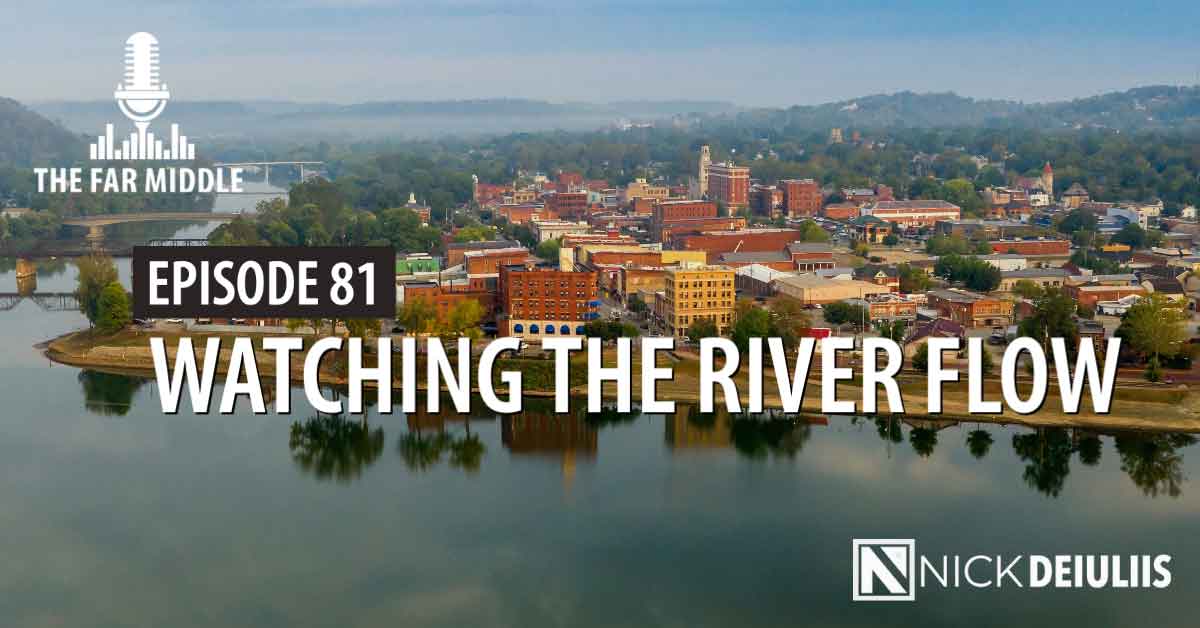
Nick transitions from trains to rivers and lands at Marietta, Ohio.

Marietta, which sits at the confluence of the Muskingum and Ohio Rivers, is the setting of this week’s episode as Nick reviews three recent presentations he delivered last week while in southeastern Ohio. The first two talks were delivered to students at Marietta College, followed by a third address to members of the Economic Roundtable of the Ohio Valley.

Listen as Nick reviews the rich history of Marietta before delving into his question-and-answer session with students. “You’re going to be me in 30 years,” Nick explained to the young adults in attendance, telling them to expect twists and turns along their career journeys.

Next, Nick summarizes his remarks given to a class on ethical leadership. “The way I approached this opportunity was to talk about baking a cake, and the cake we’re going to bake is how you build ethical leadership within a team, or a company, or an industry,” describes Nick as he walks through the steps and “ingredients” to baking a cake of ethical leadership. “Make your values come alive each and every day through your decision-making.”

Finally, Nick looks back on his address to the Economic Roundtable of the Ohio Valley, entitled, “Milton Friedman isn’t running the show anymore. And therein lies the problem.” Nick’s address reviewed six commonsense recommendations to broadly improve American society and our economy, concepts he first offered on The Far Middle in October 2021. Nick asks if we’ve made progress on these proposals this past year, or rather regressed, and then closes by tying them to Milton Friedman.


Welcome to The No-Growth Hotel

The Far Middle episode 80 features a co-dedication to both the 1980 U.S. Men’s Ice Hockey Team, and to the incomparable and prolific Jerry Rice. Nick notes Rice’s collegiate career at Mississippi Valley State and the offensive innovation of Coach Archie Cooley. The topic of innovation sparks the start of this episode’s connections as Nick moves through a host of topics like Rice weaving through a secondary.


While innovation represents growth, Nick zeroes in on the elitist organization, The Club of Rome, and their best-selling environmental book, The Limits to Growth. Nick looks at how the Club and its anti-capitalism/industrialization tenets have matriculated to the Church of Climate today and anti-growth initiatives disguised under the mask of sustainability. Nick notes the United Nations’ sustainable development goals, “outright prescriptions to stop growth and regress or reduce growth,” says Nick. He then questions how the term sustainability, a term so nebulous and hard to define, became so prevalent across society today.

What’s not hard to define is the anti-growth, anti-free market ideology of the Left, and the linear sequencing of their trap. Nick proceeds to walk through how that sequence begins with a major policy that can impact almost everything across the economy, using the slew of energy and climate policies pushed by the Left as today’s biggest example. These policies create energy scarcity, which in turn leads to energy inflation and then overall inflation as the cost of energy is an input in nearly every product and service.

Overall inflation leads to central banks fast and furiously raising interest rates. And when interest rates are raised, so too is the cost of carrying government debt. Skyrocketing debt service leads to either: increased deficits; higher taxes; and/or, reining in discretionary spending. Nick asks which of these three outcomes do you see happening as America experiences this sequencing in real time, and explains this is the trap of the Left’s no-growth approach.

Nick concludes that policies coming from the elite class—whether it be The Club of Rome or the UN—have created a situation where society is checking in but can’t check out, which brings to mind the Eagles’ December 1976 release of Hotel California.


Unrest in the Forest

The Far Middle episode 79 is a special Thanksgiving edition, dedicated to the 1979 Pittsburgh Pirates.

The 1970s Pirates were known as “The Lumber Company” due to the hurting they could do at the plate. Today, on the geopolitical stage, we see Putin trying to lay the lumber on Europe with his use of energy leverage. Nick discusses the new spin from the Left on Europe’s energy chaos, which is that Putin is helping jumpstart Europe’s energy transition. This view is simply a means to justify more climate policy mandates.

Nick proceeds to dissect, with Bert Blyleven precision, the recent quote from EU Green Deal Chief Frans Timmermans that, “Renewables give us the freedom to choose an energy source that is clean, cheap, reliable, and ours.” Following Nick’s analysis of Mr. Timmermans’ mistruth, Mr. Timmermans is presented with the first-ever Crown of Claptrap Award.

Next, Nick turns to former Federal Reserve Chairman Ben Bernanke, who won the Nobel prize for economics last month. Nick takes exception with the policies of recent Fed chairs that have created negative real interest rates, bloated asset bubbles, stoked inflation, eroded work ethic, and created a false sense of fiscal security. “No one should ever confuse Ben Bernanke with someone like Paul Volcker,” says Nick.

Related to Fed chairs is how the Federal Reserve’s leadership over the past roughly 20 years has been mono- or unipartisan under recent presidents. Nick argues the Fed has injected extreme monetary policy into the veins of our economy and the symptoms are too severe to ignore any longer.

While on policy, Nick offers a simple solution to address conflicts of interest within government: if the whole of government is going to put its power into pushing and enforcing climate policies, then the whole of government should be precluded and prohibited from profiting through the purchase (direct or indirect) of stock or equity of companies or funds in the favored industries under such policies. It’s a pretty simple solution that Nick pegs has about the same odds of being adopted as the Pirates winning next year’s World Series (currently sitting at 150 to 1).

In closing, Nick connects back to the episode’s start, linking the 1979 Pirates to one of his all-time favorite rock bands, Rush. Specifically noting the lyrics to their song “The Trees,” which was released as a single in 1979.


The Trenches

The Far Middle episode 78 is dedicated to the NFL’s unsung heroes of the trenches; including many legendary linemen who wore number 78, spanning Bobby Bell, Bruce Smith on defense, and Jackie Slater, Anthony Muñoz on offense, and many more.

Trenches, while not the most hygienic, have served as the method of choice for sewer systems across civilizations, and the modern toilet isn’t to be taken for granted. The discussion turns to San Francisco where the city recently announced one public toilet is going to cost $1.7 million with an estimated completion in 2025. Nick outlines the root causes why one public toilet costs seven figures and years to complete—causes that tie into many of the topics explored in Precipice.

From big city public toilet bungling, Nick next tackles big city public transportation messes, specifically the New York City Subway’s increasing crime and decreasing ridership. On crime and public safety, Nick addresses the overused soundbite of “be aware of your surroundings.” For individuals in bigger cities—if they truly are aware of their surroundings—then they likely realize it’s not safe to live there anymore, and it’s time to move, but that assumes the person has the job skillsets and finances to relocate. But what if they don’t have the means to move? “The poorest pay the steepest price when public institutions and public leaders don’t lead and they’re not accountable,” says Nick.

On government leadership and accountability, Nick asks if government isn’t focusing on the basics for taxpayers and citizens, then what is government obsessing about? The answer, negotiating away our national interests and leverage to further the favored ideology. A big example is what’s happening with climate change policy and related accords and regulations.

“Today, the highest levels of our governments are negotiating pacts with other nations that promise to benefit the climate in 50 years, but that clearly damage US interests today and that support our adversaries,” says Nick. He asks if such policies are doing the right thing, are a conflict of interest, a dereliction of duty or even treasonous? How many climate treaties, accords, regulations hurt America’s security, economy, and citizens, but at the same time benefit an adversary’s security, interests, and economy?

Staying on energy, Nick counters the president’s criticism of American energy companies being profitable, and their alleged refusal to increase oil and gas supply. Ironically, it’s been damaging government intervention pushing a “dog’s breakfast of a policy mess” that’s resulted in a constricted energy supply.

Nick’s final stop in episode 78 reconnects back to the New York City Subway as Nick pays tribute to musical genius Billy Strayhorn.