Understanding Today’s Left Through Berlin’s Two Concepts of Liberty

Today, the Left runs rampant through the corridors of government, academia, and treasured institutions.  It tramples over the individual and our Constitutional norms.  How did we get here?  The cautionary roadmap of the dubious journey was laid out decades ago by the great British philosopher Isaiah Berlin.  The path is best understood by Berlin’s two dueling concepts of liberty: negative liberty and positive liberty.

Berlin’s essay on the two competing types of liberty was delivered in a lecture at Oxford in 1958.1  Ironically, Berlin lamented during his prime how social and political thought in western democracies had fallen upon evil days.  He noted the alarming ease of how a professor’s abstract philosophical concepts would be weaponized by those looking to force rigid and life-stifling doctrines upon the masses.  Berlin had no idea how much worse things would get and would be shocked at today’s strict ideological environment that shackles the individual.
The Virtue of Negative Liberty

Negative liberty is the absence of obstacles, barriers, or constraints external to the individual. The person is free to choose their own way for their own good without obstruction from others.  They might make it big or fail miserably; but the doors in life are open to their choosing.  The individual is not dictated to and is left alone.

In Berlin’s words, we use the negative concept of liberty in attempting to answer the question: ‘What activities or areas should a person or group be left alone to do, without interference by others?’  Think of negative liberty as the absence of something: the something being external factors that will impede the person.  Negative liberty correlates to strong individual rights.

Negative liberty equates to the belief that it is better for a person to fail through their own volition than to succeed due to another’s benevolent control.  A person’s wishes are not to be frustrated by government.  Instead, they are to be respected.

The Opiate of Positive Liberty

Positive liberty is someone or something acting to take control of the individual’s life and to help realize the individual’s purpose.  We use the positive concept of liberty in attempting to answer the question of: ‘What or who may control or interference with someone to get them to do (or be) this rather than that?’

Think of positive liberty as requiring the presence of something: the ability to make the right decisions for oneself. Something or someone must act external to the individual to put the individual in a better position to make good choices.  Positive liberty often justifies external agents, such as government, to impose conditions to assist the individual in making good choices.  Coercion is almost a certainty with application of positive liberty.  The elimination of free will is the collateral consequence associated with the tactics used to apply positive liberty theory.

While negative liberty is attributed to individual agents, positive liberty is often attributed to collectivism or big government.  Someone or something must decide what is best for the individual and to place them on the right preordained path, whether it be a benevolent authority or an oppressive one.  People don’t know what is good for them; it is up to the state, bureaucrat, or despot to decide what is best for them.

But forcing or coercing an individual to conform their life to the view of another is a moral failing.  Thus, so too is positive liberty theory.  Immanuel Kant established the concept of ‘nobody can compel me to be happy in his own way’ and observed that paternalism is “the greatest despotism imaginable.”2

The Ebb and Flow of Negative and Positive Liberty

As Berlin showed, negative and positive liberty are not merely two distinct kinds of liberty; they can be seen as rival, incompatible interpretations of a single political ideal.  The more society embraces of one, the less it has of the other and vice versa.  To a large extent, negative and positive liberties are mutually exclusive to one another.

Ideally, society looks to strike the right balance between negative and positive liberty.  A critical mass of individual liberty must remain free from societal control and failure to do so equates to despotism.  Individuals strive to maximize freedom, yet most realize one must surrender some liberty to society to save the rest.  But if too much liberty is surrendered, we reach a point where there is nothing remaining to preserve.

The ideal society will look to maximize the amount of negative liberty and apply only the minimum amount of positive liberty to address the most pressing issues or emergencies.  That was the foundational premise of the United States.  Our Constitution was designed to permanently safeguard individual rights via negative liberty principles from the changing whims of the majority or the inevitable temptations of those in government.

Wars and revolutions are fought to establish and preserve negative liberty.  The human condition yearns for independence.  Yet people tend to let their guards down and can become complacent during good times, providing windows of opportunity for the entrenched bureaucracy and ambitious politicians to commandeer positive liberty theory to increase control over the citizenry.

Negative and positive liberty wage a battle of balance over time, particularly in chaotic democracies and other popular forms of government.  A negative liberty-laden society is created through political/societal disruption.  Followed by a slow yet steady evolution to more state control under cover of positive liberty theory.  To the point where authoritarianism reaches critical mass. And then the cycle repeats itself with a new disruption in response to an unbearable environment for the individual.

The Left’s Power Grab Via Positive Liberty Doctrine

Positive liberty doctrine has been utilized through the years by dictators, socialists, and communists to justify coercion of the individual and suppression of society.  The pitch was tempting, particularly during trying times: ‘The government, leader, or state is here to help you become a better you:  there are things beyond your control that hold you back and government will fix that. Give up your negative liberty and everything will work out to your liking.’

Over the past century, Germany and Spain (fascism) along with Russia and China (communism) jumped headfirst into embracing positive liberty and the shunning of negative liberty.  The results have been, and continue to be, devastating to individual rights, minorities, and quality of life.

The United States, which valued negative liberty and the rights of individuals to act on their own accord, served as the shining light inspiration and primary bulwark against Hitler’s Germany, the Soviet Union, and now communist China. Yet ironically, while America was leading the way, it was also slowly and incrementally slipping toward accepting positive liberty policies and diminishing negative liberty.

The slipping toward positive liberty thinking and away from negative liberty values began with Woodrow Wilson and his trust of the professional bureaucrat to know what is best for Americans.  Further sliding ensued with FDR’s New Deal and LBJ’s Great Society.  President Obama’s eight years took things even further down the scale to where government pervaded all aspects of society and economy.

Each government failure to address a targeted societal ill justified more government.  State failure bred clamoring for more positive liberty via even bigger government.  Meritocracy of the individual was supplanted by mediocrity of the collective.

In 2022 it feels as if the Left has achieved a high-water mark in American exposure to positive liberty tactics.  Individual rights and freedoms are at 200+ year lows.

Three Current Symptoms of the Left’s Application of Positive Liberty

Americans today experience a host of symptoms that betray the prevalence of the Left, big government, and the hollow promises of positive liberty.  Three particularly troubling ones stand out.

First, the Left’s doctrine of equal outcomes supplanting equal opportunity in public education cripples student proficiency and caps an entire generation’s potential.   

Government negates individual achievement at every stage of the educational journey, from preschool through university.  Entrance proficiency exams to determine admission into magnet preschools are scrapped for lotteries.  Homework and grades are dropped in high schools in exchange for the camouflage of sky-high matriculation and graduation rates.  SAT scores are no longer accepted or considered for college admissions. GPA inflation rages at universities while class rankings are no longer tabulated.  The ivory towers went from marketplaces of ideas and nurturers of free thought to the minarets of the intolerant religion of the Left.

The government and the Left tell us such educational approaches are fairer to all and erase institutional systemic biases that hold back individuals from their potential.  Yet the result is the cheating of individual achievement, meritocracy, and standards.  Every student is brought down to the same substandard experience and outcome.  Ultimately, society’s capacity is diminished when it can no longer effectively educate its incoming workforce.

Second, government used the false promise of knowing what course was best to keep the individual healthy and society safe from the Covid pandemic to justify the imposition of drastic policies that severely reduced individual rights and the free economy. 

The past three years of big government’s management of pandemic via coercion has led to economy-wide shutdowns, skyrocketing inflation, supply chain asphyxiation, record national debt, stunted educational development of kids, and reduced wellness of wide demographics.  The individual lost nearly complete control of what they did each day, week, month, and year; from their economic livelihood to their freedom of movement to what goes into their bodies.

The return received in exchange for this surrendering of free will has been grossly disappointing:  over 800,000 American Covid deaths and climbing, endless reactionary flip-flopping on policies, and the clear sense that government leaders are not following science to protect citizens but instead are imposing political science to control citizens.  Pandemic has provided an epic opportunity for the Left to institute positive liberty policy across every facet of American life.  And the Left did not hesitate to do so.

Third, positive liberty doctrine has been applied lavishly to justify the gamut of climate change policies. 

Climate change ideology is the ideal long-term opportunity for the Left to permanently impose positive liberty doctrine across society and to squelch individual/negative liberty.  That’s because energy is used by everyone and impacts everything; control energy and you control the individual, the economy, and society.  Just listen to the common rhetorical climate musings from the Left and their implied messages:

‘Climate change is the existential threat facing the world today.’ Translation: we must place society on the right track. ‘Climate change is a code red for humanity.’ Translation: we must adjust quickly to reduce the risk.  ‘The time to act is now.’ Translation: we must impose drastic policies immediately.

The evil genius of the Left is evident with climate change zealotry: convincing a large portion of the population that what atmospheric trace concentrations of carbon dioxide will do in fifty years warrants an immediate surrendering of negative liberty and individual rights.

Using Berlin’s Warning from the Cold War to Win the Current Ideology War

If you like being in control of your own destiny, if you own a business, if you want a promising future for your kids, if you believe in science and reason, and if you love your country, then heed Berlin’s teachings on the endearing promise of negative liberty and the false hope of positive liberty.  Steadfastly protect the former and be on constant guard against those promoting the latter.  More than you think may be riding on your willingness to do so.


References:

1. Isaiah Berlin, Two Concepts of Liberty, An Inaugural Lecture Delivered Before the University of Oxford on 31 October 1958.

2. Immanuel Kant, Perpetual Peace and Other Essays.
Plagues and Pandemics – Then and Now

The great Mark Twain quipped that history never repeats itself, but it rhymes.  Sometimes the rhyming can span thousands of years.  Such is the case with plague during the apex of the Roman Empire and pandemic in the U.S. today. 

A bit of background. Antonine Plague hit Rome around 165 AD, during the reign of the great Emperor Marcus Aurelius.  The entire empire was struck with the disease, which killed up to a third of the population over two outbreaks.  Aurelius eventually succumbed to the affliction, and Rome lost its great leader and the world lost one of its great Stoics (Aurelius’ Meditations in one of mankind’s great books).

Now for the rhyming.  Start with what should be simple naming convention; both diseases are labeled under various names.


The Antonine Plague, which takes its name from the family tree of the Five Good Emperors (including Aurelius), is sometimes called the Plague of Galen.  Galen was a Greek physician who diagnosed and documented the plague.  Covid-19 is the name widely used for today’s pandemic (perhaps as an accommodation to the Chinese Communist Party by the global elite more than anything else), but Wuhan Virus was utilized by some early on and followed traditional naming convention for pandemics that correlates to geographic origin (Ebola, Zika, Hong Kong, West Nile, MERS, Legionnaire, Spanish, etc.).     

By sheer coincidence, both Antonine Plague and Covid-19 emanated from the same region of China.  The Antonine Plague is believed to have come from what was then the Han Empire, which included a city named Wuhan on its peripheral edge.  Although we don’t know for certain how Covid-19 started, we do know it began in Wuhan.       

Both pandemics utilized the advanced societies and technologies of their times to rapidly spread. 

Roman roads meticulously laid out as spokes emanating from the center of Rome proved to be efficient pathways for the disease to spread from far-flung corners of the empire, to Rome, and then out to other corners of the empire.  Cheap and prolific global air travel today took a virus from one urban area to every corner of the globe within a handful of days.  Commerce further accelerated the spread of both.  Another pair of examples of how technology giveth and taketh in unintended ways.    

Antonine and Covid-19 pandemics also shared the ability to cut across socio-economic boundaries to strike down the poorest and most elite of Roman and modern society.  We have seen the most powerful world leaders afflicted with the Covid-19 virus while Emperors Marcus Aurelius and Lucius Verus were felled by Antonine Plague.  However, the two most advanced societies of their time, Rome and the U.S., struggled to protect the most vulnerable under their watch.  When it comes to pandemics, power does not equate to success or protection.  

Both plagues took their toll economically. 

The Roman Empire suffered manpower shortages of soldiers, farmers, craftsmen, and merchants.  Prices spiked for food and services due to scarcity.  The citizens demanded more state subsidy and entertainment (in the form of gladiator games) to help ease the hardship.  Tax revenues dropped at a time when the empire was already running deficits due to costly wars in Germania.  Today, special interests clamor the government for bailouts, subsidy, and endless stimulus in the name of pandemic relief.  All of it at a time when government deficits and debt levels were already at frightening heights in developed economies, including the U.S. where our federal debt now exceeds $30 trillion and inflation has just hit a 40-year high.

Let’s hope the rhyming stops, because Antonine Plague was at the highwater mark for the Roman Empire.  Many historians argue the plague catalyzed the Roman Empire’s decline.  That should serve as motivation for Americans to get our act together with rational measures designed to protect the most vulnerable in a way where our free enterprise system and individualistic society not only survive but thrive.

The Ten Greatest Guitarists in Rock History

I love rock music, and I love the guitar. But I can’t stand the rock press, particularly the politically debauched relics like Rolling Stone, who wouldn’t know a guitar god if impaled by a flying-V. Every time I come across one of these out-of-touch media outlets ranking musicians, songs, or albums into some nonsensical order, I have a Pavlovian response of reordering the proffered list into its proper sequence.

That habit offers an opportunity to contemplate the ten greatest guitarists of the rock era. Who? What order? And why? This is usually the part where the author will politely state: “there are no right answers here,” “your list might very well look different than mine and be perfectly defendable,” or “ranking these greats is a fools’ errand.” Hogwash: let’s partake in some controversial, judgmental fun and set the list straight!

Here are the ten greatest guitarists in the history of rock, in ascending order. Keep in mind, this a ranking of rock guitarists, not all guitarists. Many jazz guitarists, including Pittsburgh native George Benson, make rock guitar gods sound simply pedestrian.

#10 Tony Iommi

Iommi may not be the fastest or most technically gifted of guitarists. After all, he plays without the ends of two of his fingers, which were lost in a pre-Black Sabbath workplace accident in industrial Birmingham, UK. But what Iommi can claim is the establishment of an entirely new genre of rock: heavy metal. Specifically, the heavy metal sound. Copied and refined by musicians and bands all over the planet for decades, Iommi is the founding father of the sound and the mood of metal: dark, heavy, and relentless.

No Iommi? Then no Judas Priest, no Van Halen, and no Metallica. It is telling that so many guitar icons that came after Black Sabbath pay public homage to the man. Tony Iommi is the base of an entire branch of rock music lineage. Put on the album Paranoid and listen to a new sound when it was being created. The critics laughed then, and Iommi laughs now.

#9 Lindsey Buckingham

If you never saw Buckingham perform live, perhaps his name appearing on this list is a surprise. But to those that are fortunate enough to have seen him live, his name will not be a shock. The man exudes frightening prowess across six strings, much of it while singing lead vocals. From tracks like Fleetwood Mac’s fun “Second Hand News,” to the acoustic gem “Never Going Back Again,” to the boldly explorative “Tusk,” Buckingham’s work presents a wide spectrum of sonic colors.

Famous for his finger-picking technique, Buckingham represents the musical heart of an epic band. His solo work and solo performances offer an opportunity to experience him when he is at his most explorative. And the guy could write a decent lyric, having penned “Go Your Own Way” as the first lines for the historic Rumors sessions.

#8 Billy Gibbons

No one is better at slide guitar than Gibbons. Want proof? Just watch and listen to him with that Gibson and slide on “Just Got Paid Today.” Gibbons is the composer of some of the most iconic riffs in rock history, and he contributed lead vocals on more than a few of them. I love listening to an interview with Billy because the man is a walking archive of rock history. He’s been there and done that.

What is not appreciated by most rock fans is how ZZ Top’s 1983 breakthrough album, Eliminator, represented an avante garde moment for the genre. Most fans are familiar with how the band and the singles from that album helped propel music videos and MTV to greater heights. But Eliminator is first and foremost a progressive blues album; one that jumped from a legacy of classic blues-based rock into a sound that was blues blended with electronic music. When Billy Gibbons says Depeche Mode was an influence on him when making Eliminator, it is not a surprise. You can hear it in the songs from that album.

Great musicians take their cumulative body of art and style, observe to the left and right of them as to what is evolving, and then morph it all into something new and exciting. Billy Gibbons is simultaneously a classic blues guitarist and a rock innovator. That’s a sure-fire sign of greatness.

#7 Eric Clapton

You have to be something special when your early career lineage consists of playing guitar for the Yardbirds, John Mayall, Cream, and Blind Faith. Add to it a solo career that sold 280 million records and throw in Derek and the Dominos in the middle of it all, and you have one of the most impressive resumes in rock, guitarist or otherwise.

I suppose if music fans were spray painting “Clapton is God” on London walls in the 1960s, he has to find his way on this list. Yet although I like Clapton, I don’t love him as much or rank him as high as most guitarist aficionados would. The primary reason ties to the passage of time. His best work was Layla and Other Assorted Love Songs when he was with Derek and the Dominoes, and most of those songs were cowritten with others or covers. That album was released over 50 years ago.

Clapton’s solo career after Derek and the Dominoes was full of radio hits and sales successes. But the past 50 years have not produced much in the category of ground-breaking or awe inspiring. Strangely, the more successful Clapton has become over the long haul, the less he seems to stand out. But based on what he did up through 1970 alone would place him on this list.

#6 Alex Lifeson

Canadian Lifeson is the most underrated guitarist in rock. He’s complex in the studio and he’s inspiring live. There are a dozen Rush singles that have more variety and moving parts than entire albums for other acts, and the band’s guitarist is a big reason why. “Spirit of the Radio” off Permanent Waves is probably the best exemplar of Lifeson’s approach: sharp, rich, complex, diverse, and unforgettable. There’s four different songs meshed into that one single.

The beauty of Rush and Lifeson is that they offer something for everyone. You like progressive rock? 2112 is your album. You like the arena anthems? Blast “Tom Sawyer” in the car. You want introspective lyrics? Listen to “The Trees” and how it resonates today more than ever. You enjoy musical sophistication? Stream “La Villa Strangiato” through headphones and try to figure out how he plays those guitar parts. Care for some synth-rock? Give Power Windows a spin on the turntable.

Rush is such an insanely talented band that most people consider Alex Lifeson to be the least accomplished of the power trio. That’s what happens when your fellow band mates are Neal Peart on drums (and lyrics) and Geddy Lee on bass (and vocals), probably the best at their instruments in all of rock. With the passing of Peart, one of the most prolific and varied acts in rock history is likely at an end. But at least we still have that massive and impressive catalogue to fall back on.

#5 Jimmy Page

Jimmy Page sports the most accomplished resume you will find for a rock guitarist: successful session musician, Yardbirds, Led Zeppelin, and host of later supergroup bands and collaborations including The Firm. His resume of riffs forms an endless loop and includes a foundation of “Heartbreaker,” “Whole Lotta Love,” “Black Dog,” “Communication Breakdown,” and “Rock and Roll.” Couple to all the substantive accomplishments his unique stage performances (using a cello bow to play guitar and playing a 12-string double neck guitar) and his offstage interests (including his obsession with mysticism and buying occultist Aleister Crowley’s home in Scotland), and you have the complete guitar god.

If you want a tour de force live concert performance that projects the talents of Jimmy Page, give a listen to him playing with the Black Crowes at the Greek Theater in Los Angeles. From the Led Zeppelin songs to the classic blues covers, this album is Page at his absolute live best.

He wrote the music for “Stairway to Heaven,” what most consider to be the greatest rock song of all time. He was steeped in folk music and the blues. Books have been written about his exploits, the best being Hammer of the Gods. And his peers worship him, from Eddie to Edge. Jimmy Page took a talent and turned it into the complete professional career package.

#4 Brian May

May is the smartest individual on this list of musical geniuses. He earned a degree in physics from the Imperial College London in 1968 and was then awarded a doctorate in astrophysics from the same esteemed institution in 2007. In between his physics and astrophysics diplomas, Brian May set the world ablaze with his guitar in Queen.

There are bands that do classic rock extremely well; but there is only so far one can take it before it becomes repetitive and depleted. There are other bands that do experimental and progressive rock very well; but the complexity appeals to only a small portion of the wider listening audience. Mixing the two together is typically untenable for most musicians and acts and will spell commercial disaster.

What was special about May and Queen was their ability to take the eccentric and innovative and wrap it within a hard rock package so that it appealed to the masses. “Bohemian Rhapsody” is Queen’s masterpiece on Night at the Opera and is rightly considered one of the greatest songs of the rock era. Yet the song breaks every rule of a hit rock record: it’s long, it’s operatic, it tells a strange story, and it shape shifts from piano ballad to power chord anthem. It takes uber talent to pull off the magic of composing and producing such a composition in a way where it achieves universal enjoyment. Freddie Mercury wrote and created most of it, but Brian May built and structured most of it so that it worked. What a dynamic duo.

For a hidden gem of guitar history, check out Brian May’s Star Fleet Project, an early 1980s mini-album he collaborated with Eddie Van Halen on. Would’ve loved to have been in the room or studio when that was being made.

#3 Stevie Ray Vaughn

There are those who will say SRV is technically a blues guitarist and thus should not be ranked in a rock list. Although Stevie’s roots were clearly the blues, his body of work doesn’t just fit well in the rock genre, it redefined it. Look no further than how he reset David Bowie’s image during the 1980s with the riffs on “Modern Love” and “Let’s Dance.” The greats have the ability to redefine other greats.

You don’t listen to SRV, you feel him. Give “Couldn’t Stand the Weather” a listen and you will certainly feel him. Maybe that’s the result of a kid who started playing when he was seven and who’s older brother Jimmy had a bit of musical talent of his own. Something was in the water down there in Dallas, Texas.

The most impactful aspect of Vaughn’s art was how he meshed his voice and his guitar into a singular sound; the voice and the guitar spring from the same source and share a common DNA, one a natural extension of the other. A raw, unbridled talent that has not seen its equal since his untimely death in 1990. A career of seven short years leaves one wondering what might have been had he lived longer.

#2 Jimi Hendrix

Johnny Allen Hendrix would’ve boasted an impressive resume before his solo career, backing the Isley Brothers and Little Richard on guitar. But in four short years of a solo career that spawned three classic studio albums, Jimmy Hendrix established a standard that remains non-replicable to this day.

This innovator was the definition of unconventional. He played a right-handed guitar upside down (Hendrix was ambidextrous, playing guitar and throwing baseballs left-handed but writing right-handed). Hendrix amazed in the studio. He awed audiences live with his playing and with his showmanship, from flaming guitars to the “Star Spangled Banner” at Woodstock. Nuisances and problems to mortal guitarists became creative tools for Hendrix to master, with the best example being his harnessing of amplifier feedback.

Hendrix arrived in England in 1966 and immediately scared Eric Clapton off the stage when Hendrix joined Cream on stage and blew Slowhand away. He then shocked the rest of British rock royalty that included McCartney, Richards, Jagger, Beck, and Townsend, when Hendrix played his own London shows a bit later. Every guitarist loves Hendrix, yet no one can play like Hendrix. Just ask Clapton.

#1 Eddie Van Halen

There is no other plausible choice for numero uno. Edward Ludwig Van Halen put signature into signature sound. Every rock guitarist, from the professional global star to the basement amateur, measures the timeline of the rock guitar with BE and AE: Before Eddie and After Eddie. You can identify a Van Halen tune within three notes.

Van Halen was a technician, building and wiring his guitars, with the most iconic being his red, white, and black striped Frankenstrat. He was an innovator, stylistically and sonically, from finger tapping to “Eruption” to “Mean Streets” to power drills. Yet the guitar and all his innovations were not enough to allow his artistic expression to freely flow, and thus his move to keyboards in the 1980s brought an entirely new dimension to the EVH sound.

His home studio in the Hollywood Hills, 5150, had floor-to-ceiling shelves filled with tapes of his recordings. One can only hope that someone (Wolfgang, are you reading this?) takes the time to inventory and release those time capsules to a world hungry for anything that announces itself as Eddie Van Halen.

Like many talented performers, Eddie suffered from bouts of substance abuse and health issues. But one thing rang clear in sound and sight: when Eddie Van Halen held a guitar in his hands, he was the happiest man alive. I miss that guy.

The Next Ten

There you have it. With only ten spots, more than a few truly great musicians didn’t make the cut. The next ten in no particular order are: Chuck Berry for creating the art form, Ritchie Blackmore of Deep Purple and Rainbow, Carlos Santana and his emotion, George Harrison and his beautiful ballads, Gary Moore with his Corridors of Power masterpiece, Edge with his sonic layering, Joe Perry and his classic riffs, Randy Rhoads as the second coming of Eddie Van Halen, Duane Allman for creating the jam band and southern rock, and Jeff Beck because he is Jeff Beck.

Rock on.

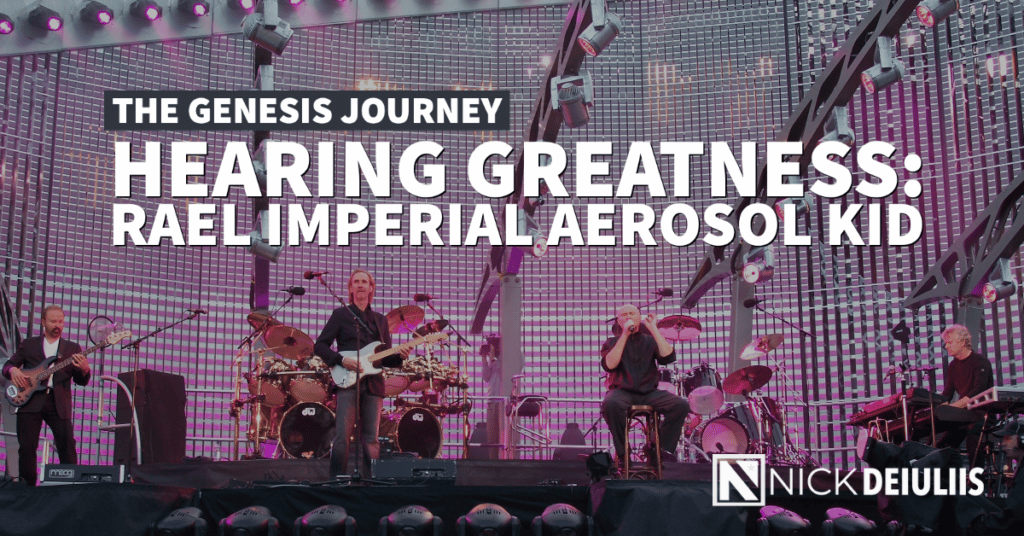
Hearing Greatness: Rael Imperial Aerosol Kid

Readers of this title fall instantly into one of two categories: those who immediately know the subject matter or those completely clueless to it. That’s because the title borrows a line from one of the more famous songs in the subject’s song catalogue. The song is “The Lamb Lies Down on Broadway” and the subject is the rock group Genesis.

I’ve waded into exploring/revisiting the music of Genesis these past few months. Mostly exploring, as my past experience with Genesis was mostly limited to the latter part of the Phil Collins-as-lead-singer era, from the mid-1980s and beyond. I am grateful for this recent happenstance, yet fruitful, journey. For it has awakened in me the realization of the genius of Genesis, one spanning decades. Despite considering myself a rock aficionado, I had no clue of the impressive extent of this act’s body of work.

Genesis’s uniqueness is best understood through the lens of time relative to their contemporaries. There is the exclusive subset of rock acts that are truly great bands led by talented musicians. Then there is the even smaller category of great rock bands that climbed the mountain of success twice with two different lead singers: legendary acts like Van Halen (Roth then Hagar), AC/DC (Scott then Johnson), The Doobie Brothers (Johnston then McDonald), and Black Sabbath (Osborne then Dio). Finally, there are the rare great acts that successfully evolved from one genre to another (Prince and David Bowie are two that come to mind).

Yet there is only one rock band that was great, achieved epic success with two different lead singers, and impressively evolved genres from a progressive rock band into a straight-up rock band and then into a pop/top-40 band: Genesis. Let’s explore the three acts of the Genesis journey.

The First Act: Peter Gabriel-Era and Prog Rock Trailblazers

The genesis of Genesis starts in England during the late 1960s. The group during the earlier years was comprised of supremely talented musicians: Peter Gabriel on vocals, Steve Hackett on guitar, Tony Banks on keyboards, Mike Rutherford on bass/guitar, and an underrated Phil Collins on drums. Hardcore Genesis fans typically point to this era as the most impactful, often citing the albums Foxtrot, Selling England By the Pound, and The Lamb Lies Down on Broadway as three of the group’s best.

This early configuration of Genesis was all about prog rock. Poetic lyrics, expansive songs like “Supper’s Ready” (spanning twenty minutes), and extended song interludes where the members’ instrumental talents were indulged were hallmarks of Genesis during this era. Stage shows became elaborate productions with lasers, props, and slide shows. Peter Gabriel toward the end of his tenure with the band started to appear in concert in outrageous costumes and makeup, often drawing all attention to him and, in the eyes of some, detracting from the music and the rest of the band.

Worries about Gabriel stealing all the limelight were short-lived as the band had to deal with his sudden departure at the end of The Lamb Lies Down on Broadway tour in 1975. Gabriel’s surprising decision to leave (listen to his lyrics to his solo hit “Solsbury Hill” for a sense of how he came to the decision and the aftermath) may have been a bit of a relief to other members. But the timing was painful since the band was just starting to make it and was in financial debt despite methodically growing its following.

Personally, I like this era and its albums, with each one having a couple of classic numbers. There might not be a more beautiful song in rock than “Carpet Crawlers” from The Lamb Lies Down on Broadway (what a line: ‘you gotta get in to get out’). “I Know What I Like (In Your Wardrobe)” is great off Selling England By the Pound. And “Watcher of the Skies” is a great opener on Foxtrot. But for me, the best was yet to come for Genesis, with its next incarnation going on an epic creative run that no one saw coming.

The Second Act: Phil Collins Grabs the Mic and Genesis Achieves International Success

With Peter Gabriel gone, the future of Genesis was far from certain. Phil Collins suggested going entirely instrumental, an idea that was thankfully shot down by the other members. Potential new lead singers were auditioned, with no success. Only when Collins laid down vocals for the classic song “Squonk” during the recording of A Trick of the Tail did Genesis realize its next singer was already in the band, sitting behind the drum kit (Collins does an amazing job with challenging vocals on “Squonk,” which his impressive considering it was the first song he tackled as frontman).

Turns out Phil Collins was quite the lead singer and songwriter, propelling Genesis on a dizzying arc of artistic achievement. The early Collins-led albums of A Trick of the Tail and Wind and Wuthering were impressive for preserving the group’s special prog rock flavor from the Gabriel era while injecting a newness. Fans accepted Collins from the get-go, wanting him to succeed as an old member of a favorite band in a new role.

When legendary guitarist Steve Hackett left the band after Wind and Wuthering, Genesis did not miss a proverbial beat. The next album, And Then There Were Three, offered up the band’s first hit single, “Follow You Follow Me.” Then came a trio of successive albums that defined Genesis in more ways than one: Duke, Abacab, and Genesis. These three albums delivered international success, made the individual members famous, and set a template for how to be a successful rock group.

Duke is my favorite Genesis album. “Behind the Lines” is an all-time great opening track and the next track “Dutchess” is awesome. “Misunderstanding” and “Turn It On Again” are a pair of songs that are about as Genesis as it gets. What I like most about Duke is the ease and positivity of the music; you can listen to the music and tell this album came together organically.

Although Duke is my favorite album, Abacab is not far behind. If you want a forgotten gem of a song, check out “Keep it Dark” off Abacab. And the album Genesis will always have a special place in my heart, as it was the first Genesis album I owned and one of the first records I bought as a kid.

At the end of 1983, Genesis was at the height of its powers and sat in the top echelon of rock acts. Give me these three albums on a deserted island (with a power source, of course) and I am happy for a long while.

But nothing lasts forever, and change is life’s only constant. Truisms for all of us, including Genesis, as they exited the second era and entered the next.

The Third Act: Epic Commercial Success and Lost Edge

Turns out Phil Collins wasn’t just a solid drummer and great lead singer, but he was also a song-writing machine, churning out hit records in rapid succession. He was so prolific that he ran a hugely successful solo career in parallel with Genesis work, as if Genesis was not enough to contain his creative juices.

Amazingly, Collins was creating some of the most classic Genesis albums while he was simultaneously releasing hugely popular solo albums. The dates and lines blur in the early 1980s: the solo albums Face Value, Hello I Must Be Going, and the commercial monster No Jacket Required were being created and issued at the same time of the Genesis trilogy Duke, Abacab, and Genesis. Here’s an impressive bit of trivia: only three individuals in the history of rock succeeded in selling 100 million albums as a part of a group and another 100 million albums as a solo artist: Paul McCartney, Michael Jackson, and Phil Collins.

The combination of Collins’ creative genius coupled with his workaholic mindset were the catalysts to this third, and in my opinion, least inspiring era of Genesis: the pop, top-40 era. This last act of the group ended up mirroring what Phil Collins was creating with his solo work. Made for radio airplay and MTV, catchy, and popular selling singles packaged in albums that resembled little of the band’s epic legacy. If this was the era of Genesis where you were introduced to the band (which is partly the case for me), then you risked being not just underwhelmed, but oblivious to the greatness that was visible in the rearview mirror of the band’s recent past.

The albums from this era, mainly Invisible Touch and We Can’t Dance, were quite popular and did extremely well on the charts (both albums peaked in the top-five on Billboard in the US). And each carried mega-hits including the two title tracks, “Land of Confusion,” “In Too Deep,” and “Tonight, Tonight, Tonight.” But numbers aren’t everything when it comes to music, and the third act of Genesis just doesn’t do it for me.

Normal People Doing Extraordinary Things

My recent, deeper dive took me from liking Genesis to loving them. That transition was largely driven by a better appreciation of their music, particularly from the first two eras. But there are two other intangibles I admire about Genesis.

First, this is a band that stands entirely on its music. Outside of the period where Peter Gabriel went a little, shall we say, eccentric on stage, Genesis let the music do all the talking. Imagery is captured in the lyrics and rhythms, not in the glossy shellac of the album cover (although I really like some of those covers) or outfits and hair styles of the musicians (Phil Collins dresses like most of us at the office on a casual Friday).

But another intangible was coming to see the individual members of the group as gifted, intelligent, yet hugely unassuming people. You can’t get less ‘rock star’ in attitude than Phil Collins offstage. Scores of critics lambast Collins, but he succeeded in making Genesis accessible to the masses with the most understated of front men personas. Keyboard wizard Tony Banks strikes me as someone you’d talk investing or physics with, not party all night long with. And Mike Rutherford appears an everyday guy who you sense wrestles with the same life questions most of us do.

Genesis performs this coming week in the Steel City, and I will be there. Yes, it’s tough to see Phil Collins struggling physically, a reminder that life is short and health is precious. But watching normal people doing extraordinary things while remaining normal is special. I like the sound of that. But I like the sound of Genesis even better.

Ode to Los Angeles From a Wary Admirer

I recently visited one of America’s iconic cities and one of my personal favorites: Los Angeles. Modern day LA simultaneously exemplifies the exciting and the troubling of the nation’s urban areas. Potential remains exponential while risks and problems accumulate.

Flying into LA from the east, the transition from barren desert (excluding the oasis of Palm Springs) to the fertile urban sprawl is sharp, with the San Jacinto Mountains acting as an impressive physical wedge between two binary worlds. In daytime, flyers’ views transition from brown nothingness to megacity sprawl. At night the black void suddenly switches to a sea of light. The Los Angeles basin makes its impression on visitors from the air before they step on terra firma.

Looking out the plane window on the approach to LAX during this visit, my attention was immediately drawn to the port of Long Beach. Those familiar, massive ship unloading cranes were lined in neat rows, starting the nation’s physical infrastructure chain from the Pacific’s edge moving inland: interstate, power transmission lines, rail, and truck intermodal container flow. Long Beach from above is an impressive exemplar of crucial supply chain links.

But this time there was something noticeably different with the port view: large clusters of container ships huddled at the port mouth and long lines of ships stringing out to sea from the clusters. The image reaffirmed the obvious: quality of life hinges on a supply chain that is subject to risk. You can tout the best of physical infrastructure, but to properly function one also needs focused execution operating under sound policies. The logjammed fleet at the port mouth proved misguided government policies adversely affect execution, which damages the nation’s supply chain, which hurts quality of life from sea to shining sea.

Los Angelinos recently learned how one supply chain bottleneck can damage other links of the supply chain. Huntington Beach and Newport Beach south of LA recently dealt with an oil spill from an undersea pipeline. Environmentalists, media, and leftist politicians were quick to assign blame to the negligence of the oil industry, pointing to the spill as yet another example of how profit and carbon are ruining the planet. But before you could say ‘climate change’, it turns out that the rupture of the pipeline is now suspected to have been caused by one of those waiting cargo ships that dropped anchor and then drug it across the sea floor, catching and then pulling apart the pipeline. The Orange County shoreline became another casualty of a broken supply chain triggered by inept policy.

Obvious fixes won’t come easy. California’s political leaders and regulators will not provide a smooth path to increase truck traffic flow out the port of Long Beach. California already limits the supply of able trucks by its Truck Ban regulation, which bars permits for large trucks that predate the 2011 model year. Politicians’ sound bites on local radio and quotes in local papers were citing the need to immediately increase regulation of traffic flow into and out of the port and surrounding communities. That’s code for more bureaucracy, cost, and inefficiency. All of it spelling trouble for the broader economy.

I used a driving service this trip to get to and from meetings and locations. Now I must confess, one of the biggest enjoyments I get from business travel is spending the better part of a day talking to the driver going from meeting to meeting. Sometimes the driver prefers quiet, but most are happy to be sociable and share thoughts and insights of a true local. No matter where the city, you will learn a lot about its people and culture by simply listening to the driver.

On this trip, I was lucky to have the latter with the driver for the day; let’s call him Sam. Sitting in the morning rush around the upscale Beverly Center, we engaged in a conversation about what Los Angelinos refer to as the ‘crisis.’ No, it’s not climate change. Instead, it’s the homeless epidemic. And it is getting worse.

On the sidewalk alongside the Beverly Center was a homeless structure, somewhere between a tent and a house. The rectangular structure ran about 30 feet in length and nearly the entire width of the sidewalk, leaving about two feet for pedestrians to pass through. The corners and middle of each side were anchored to lumber studs, with the height around six feet. The occupant installed rectangular windows along the side walls and covered them with clear plastic. A small grill and lawn chair sat alongside the structure in a makeshift patio area.

It was a strange combination of feelings: being impressed by the builder’s ingenuity and being depressed by the obvious human plight of living on the street. As Sam and I were admiring the workmanship while sitting in the traffic, a police vehicle drove by. I asked if police enforce vagrancy laws with homeless. Sam laughed and replied they did not. Half a block up the street, the police vehicle sounded its siren and pulled up behind two late model foreign cars with hazard flashers on parked in the right lane in front of a Starbucks. The cop issued tickets to the vehicle drivers who left the cars parked in busy traffic lanes during the rush hour.

So much in those thirty seconds reflects the reality of LA: extreme poverty rubbing up against extreme wealth, police enforcing some laws and ignoring others, everyone going about their daily routine impervious to it all. Most depressing of all: a growing acceptance by all, from the homeless to the wealthy, that homelessness is unsolvable and here to stay.

Like magic, five minutes later while still waiting to get through the same jammed intersection, the radio newscaster informs us that LA City Council, that body of epic ineptitude, voted to ban homeless encampments across three city districts and within 500 feet of schools and libraries. Just over fifty sites will be affected, with the newscaster telling us it reflected less than half of the locations that were under original ‘consideration’ for the homeless ban this summer. The rule will be enforced two weeks after signs are posted in the areas. The estimated cost of the signs is close to $2 million. Sam the driver is highly confident the move will not improve the homeless situation, would not be surprised if it makes the situation worse, and is certain the $2 million could be put to much better use than signage. I agreed but told him to think of the windfall for the government bureaucracy: a whole new horizon of regulations, debate, and process to feed from without having to solve anything.

This mid-October during my visit, the Dodgers were chasing another World Series title and hosting the Atlanta Braves in the National League Championship Series. I’ve been a life-long Dodgers fan, with the Dodgers second in my heart only to my hometown Pirates. Those 70s and 80s teams managed by Alston and Lasorda were awesome and the setting of a game at Chavez Ravine on TV provided one of my first impressions of southern California. Dodger Stadium was packed, as expected, although Dodgers fans were true to form by arriving fashionably late and taking three innings to fill the stadium.

But even spectator sports don’t escape the grasp of the administrative state these days, especially in the elite bureaucratic haven that is California. Medical ‘experts’ were on the airwaves over the week cautioning how cheering and chanting at sports venues can increase the risk of spreading or being infected with Covid. From what I could tell, no one was listening to these ‘experts’ at the games.

Perhaps the biggest surprise during the trip was the how empty restaurants were.

Many restaurants have shuttered or scaled back days and hours of operation, due to a combination of lack of customers and a shortage of workers. Despite the reduced capacity of the dining sector, there were lots of empty tables during lunch and dinner hours. An owner of a popular Hollywood restaurant summed it up: “It’s always been excruciatingly expensive to run a business here, but you could shoulder it if you offered top product. Now though, we are told to shut down and then when we reopen the government makes it even more expensive to get people to come work and makes it more painful for customers to eat out. It’s been a death knell for lots of great establishments.”

As businesses and the private sector get crushed in California from excessive and heavy-handed government bureaucracy, government itself is doing quite well.

The week I was in town Governor Newsom was bragging that the state will have another “historic budget surplus” next year, following a massive surplus this year. The reasons for the twin surpluses? Massive subsidy from the federal government to California under banner of Covid relief (translation: wealth redistribution from fly-over country to coastal elites), government dropping services and expenditures during its own mandated shutdowns (translation: government stops doing its job to save money), and taxes filling the state coffers (translation: value creators in the free market get no Covid relief and must continue to pay up to support bureaucrats). The pandemic has been very, very good to California government.

On energy matters, it is crystal clear that greater Los Angeles will not be anything close to carbon neutral in our lifetimes.

Heavy vehicle traffic is everywhere (still predominantly combustion engine vehicles on the 405 Freeway), the metropolis is a sea of lights at night, climate (indoor) is controlled, everyone is staring at charged phones, and the consumption of carbon-based products abounds. The power grid demand is growing and things like wind and solar can’t come close to filling it reliably.
But state and federal government keep doing all they can to make carbon prohibitively expensive for the middle class and working poor that rely on it to earn.

Gasoline prices were averaging more than $4.50 per gallon in state during my visit. The wealthy elite driving subsidized electric vehicles or expensive late model foreign vehicles could not care less about the price of something as incidental to them as gasoline. But the army of service providers and small business owners scrapping every day to eke out an income underneath a mountain of regulation, taxes, and bureaucracy are facing a fuel cost straw that will break the doers’ backs.

Crime, both property and violent, is a problem in LA like most large American cities. The morning of departure brought news of an overnight shooting claiming multiple victims. Homicides in LA spiked in 2020, totaling nearly 350, and are on pace in 2021 to surpass last year’s number. Security cameras cover every imaginable angle of home exteriors across every neighborhood; yet one wonders if all the surveillance video feeds and security signs in yards deter any property crime in the end.

Marijuana is not just legal in California, it is everywhere. You don’t see it, but you certainly smell it: walking outside on a neighborhood street, driving in traffic, or strolling around a shopping area. And the odor is present morning, noon, and night. I read the studies that show moderate marijuana consumption is less damaging to health than tobacco or heavy alcohol consumption, and I tend to agree. But one wonders what the cumulative effect is on society when many of us are continually numbed and drained from regular marijuana use. I fear the answer may be more couch slouching and less achievement. That’s not the American way.

Flying home on a carbon-fueled plane, I had time to reminisce about my couple of days in LA. Southern California reflects the dichotomy of modern-day America: a proud legacy and an embarrassment of riches colliding with a cresting wave of problems that may deliver an unsustainable tomorrow. Although I continue to root for LA, the scoreboard is flashing trouble.