Unsustainable: American K-12 Public Education

The quality of an American public education has been steadily eroding for years. Today, many school districts are graduating children without basic proficiency in reading, writing, math, and science. These kids enter the job market and real world unprepared and unarmed. Meanwhile, spending on K-12 public education has skyrocketed.

Taxpayers pour money into an education system that produces increasingly disappointing results. Amazingly, the embarrassing failures in public education are used as justification to throw more taxpayer dollars at special interests creating the problems.

In a world where everyone marches to the drumbeat of sustainability, our public education system has sunk into a quagmire of unsustainability.

What are this crisis’ problems, root causes, and solutions? Although the situation is complex, the major drivers are quite simple. Covid and the self-induced shutdown of our schools exacerbated and exposed these drivers for all to see, making them more obvious. Ignoring them surrenders our kids’ futures.

Stakeholders and Their Interests

To properly understand the problems and root causes, and to identify solutions, understanding the stakeholders is key. They are:

  • Students, parents, and taxpayers. These are, in theory, the public education system’s customers. Kids need to be taught basic skills, parents desire good outcomes for their children’s education, and taxpayers pay for all of it. If our public education system fails, all three lose.
  • Good educators. Motivated teachers are one of the most powerful assets in a free market economy, providing a multiplier effect on value creation as they develop productive doers. Great instructors deserve and want recognized through merit pay and professional advancement.
  • Bad educators. Like any professional occupation, there are both good- and poor-performing teachers. A poor performer not interested in improving seeks to continue collecting a paycheck and wants to avoid accountability.
  • Teachers’ unions. Public unions, unlike private sector unions, should be viewed with skepticism since collective bargaining and strikes harm the citizenry that the government worker pledged to protect. The public union is most interested in preserving and growing its power, in the form of increasing dues and membership. Rewarding great educators, classroom meritocracy, and academic proficiency are secondary considerations. That’s why studies struggle to find a correlation between teacher unionization and improved student outcomes.
  • School administrators. Administrators, conceptually, sit in between the teachers’ union, teachers, and customers (students, parents, and taxpayers) to create balance and a quality education. Instead, administrators often focus on using bureaucracy to justify more influence, grow staffing, and increase budgets.
  • Politicians. Public officials are elected by the customers of the public education system: parents and taxpayers. But politicians often fail to serve those who they supposedly answer to. Instead, politicians are increasingly influenced by what their true bosses, public unions, demand from them: a system that shrouds transparency, shirks accountability, is fed more money, and limits customer choice.

The Problems

You can’t identify root causes until you recognize the problems. Unfortunately, the problems are obvious and serious.

  • Increasing and alarming numbers of kids are matriculating through public schools despite lack of basic proficiency in reading, writing, math, and science. Schools are failing in their most fundamental duty: to teach students.
  • Urban and rural school districts are especially susceptible to not fulfilling their duty to students. That means the poorest and most economically disadvantaged communities suffer the most severe consequences.
  • Teachers’ unions secure work rules where teachers are all treated the same, as if they were a commodity instead of a profession.
  • The best educators are not recognized nor compensated fairly.
  • It is far too easy for poor performing teachers to skirt accountability, with the system allowing them to remain entrenched for decades.
  • School choice options for parents and students are too limited, particularly in poor performing school districts.
  • Teachers’ unions willingly use threat of strike to disrupt learning and students’ educational paths, if it helps secure more money for pensions, adding of non-teaching staff, and more favorable work rules.
  • Too small of a fraction of each dollar poured into public school districts ends up in the pockets of active teachers or to hire more teachers.

The Root Causes

What are the root causes of these major problems?

  • Community-wide problems, such as lack of economic inclusion, often adversely influence public education outcomes and student proficiency. Solving such problems is beyond the scope of this discussion, and we touched upon some of them in a prior commentary [Teens and Avoiding Poverty: Three Simple Yet Challenging Rules]. Yet addressing the other root causes below will place families and school districts in our more challenged urban and rural communities in better position to succeed.
  • Public unions, including teachers’ unions, pose a massive, cyclical conflict of interest. Teachers’ unions collect dues from member teachers, the unions use dues to fund the political campaigns of politicians (legislators and elected judges) in their districts, the elected politicians then appoint administrators to manage school districts, and collective bargaining agreements are negotiated by the trio of teachers’ union-administrators-politicians that favor the teachers’ union priorities over those of students, parents, and taxpayers. Repeat for the next contract and election cycles.
  • Teachers’ unions exist without any current teacher ever having voted to form the union in the first place. Only one percent of teachers in Florida’s ten largest school districts were on the job when those districts voted to unionize. The New York City public school system teachers’ union, the United Federation of Teachers, was created in 1960, meaning no one out of the over 100,000 current teachers in the union ever voted to create it. Most public school teachers had a union forced on them from day one of their careers. This is institutionalized conscription of public schoolteachers, districts, and the students they serve in the form of a perpetual public union.
  • Most collective bargaining agreements impose a system whereby marginal teachers can continue teaching without improvement for decades and excellent teachers enjoy little upside in the form of professional advancement and pay. Frustrated parents and exceptional teachers may feel as if the system was designed to protect the poor teacher.
  • The teachers’ union top priority is securing more dues and higher membership. Student proficiency, school choice, and teacher accountability are distant, secondary concerns. When there is conflict between the top priority and lesser priorities, the teachers’ union will choose the former at the expense of the latter. That’s a big reason why students who matriculate the full twelve years through a school district with mandatory collective bargaining end up on average earning less, having jobs requiring lower skills, and being more likely to be unemployed than fellow students in school districts who did not have statutorily mandated collective bargaining.
  • A growing share of “investment” in education is allocated under collective bargaining agreements to fund underwater and out-of-market pensions for retirees and to grow staffing of non-teaching personnel. The rate of increase is alarming: over 14% of education spending in 2018 was to cover pension costs, compared to only 7.5% in 2001. The Los Angeles Unified School District has seen pension costs more than double since 2014. In West Virginia, student enrollment fell 12% from 1992 to 2014 as non-teaching staff increased 10%, and in Kentucky over the same period non-teaching staff grew over six times as fast as student enrollment.

Solutions to Make the Unsustainable Sustainable

The K-12 public education system is unsustainable and in terminal decline. Yet a few simple reforms would drastically improve the situation for students, parents, taxpayers, and great educators.

  • States should enact statutes that require teachers’ unions to stand periodically for recertification, allowing active teachers to make their own decisions as to whether they desire union representation.
  • Politicians and administrators should prioritize within school district budgets active teacher salaries and student-teacher ratios (meaning new teacher hires) over pensions, retiree healthcare, and hiring of non-teaching staff.
  • Collective bargaining agreements and administrators must clearly define measurable performance criteria for student proficiency levels in reading, writing, math, and science. If those proficiency levels are not met, it should trigger preestablished corrective actions to ensure accountability and to protect students.
  • A true meritocracy should be instituted when setting teacher merit increases, promotions, and advancement opportunities. The best teacher in a school should earn substantially more than the poorest performer. The best should advance to more responsibility and opportunity while the worst should be considered for removal in lieu of improvement.
  • School choice should be encouraged via policy and be an option for students and parents, particularly in school districts that post poor student proficiency levels. If public education is not serving the customers with the quality product that the customer paid for, the customers should be free to take their business elsewhere.

Although these simple reforms would drastically improve the lives of countless children, accomplishing the reforms will require long, brutal campaigns on a state-by-state and school district-by-school district basis.

Yet we would be hard-pressed to find a more worthy fight.

Liberal vs. Leftist: Trendy Labels Obfuscate, But True Meanings Matter

Question: Liberal or Leftist, What’s the Difference?

Answer: Everything.

A very bad habit has developed across society the past few years: lumping together two things that are quite different. In fact, so different that further reflection reveals these two things are nearly opposites. Yet people far and wide keep interchanging them as if they are the same.

The problem relates to confusing a liberal with a leftist. They are most definitely not synonymous. Our nation needs more of the former and to recognize the sinister danger growing with the latter. So, consider this Civics 101 crib sheet to allow you to better spot each, and subsequently embrace the liberal and reject the leftist.

A liberal is a champion and defender of individual rights. Perhaps the best illustration is how a liberal will staunchly defend the right to free speech and freedom of expression. A true liberal values the Bill of Rights as much as the Constitution, for they recognize without the protection of individual rights, other protections for the citizenry found in the Constitution will not matter much.

A leftist views individual rights as a threat to be suppressed to benefit the collective. That’s why leftists display an affinity to censor, shout down, and strangle dissenting opinions and conflicting views across the public square, academic quad, and media newsroom. All under the official banner of protecting the public from ‘hate speech’ and ‘misinformation’.

A legitimate liberal is a proponent of capitalism, recognizing value creation and personal achievement benefit the individual as well as the market economy. Yes, many liberals favor more government regulation of economic activity than a conservative or libertarian. Nevertheless, the virtues of a free-market economy are obvious to the liberal.

A leftist abhors capitalism and instead insists on a command economy, where the state dictates capital allocation, industry winners, and industry losers. Leftists adhere to either socialism or communism, depending on the facts and circumstances of the situation.

A liberal supports the concept of the nation-state, recognizing citizens are members of distinct nations with unique cultures and attributes. Formal borders and national sovereignty are respected.

A leftist is anti-nationalist. People are not citizens of a nation, but instead are members of the global community. Borders don’t matter and, in fact, should be disregarded. Leftists don’t differentiate by national identity and instead differentiate by class.

If you have been mistakenly mixing and matching your liberals and leftists, don’t be too hard on yourself because you are not alone. Media talking heads, political pundits, and self-proclaimed ‘reliable sources’ do the same.

Consider inherently biased Wikipedia. Look up ‘list of American liberals’ and peruse the politicians named as liberals. You will find Bernie Sanders (along with Kamala Harris, Elizabeth Warren, and Pete Buttigieg). The Bern is a died in the wool leftist, so much so the cranky one spent his honeymoon in the USSR. Labeling Bernie Sanders as a liberal is an insult to liberals and gives more credit to Sanders than he deserves—serving as yet another illustrative warning to those who assume if one reads it on Wikipedia, it must be accurate and balanced.

Confusion with discerning liberals from leftists is wreaking havoc with the workings of the Democratic Party, creating party-wide dysfunction. What is in fact an internal party civil war between the liberal core and the leftist extreme wing has been inappropriately mislabeled, by negligence or intention, as a battle between ‘moderates’ and liberals.

A moderate is someone falling between classic conservative and liberal philosophies, not someone sitting on an imaginary spectrum between a liberal and a leftist. Senator Manchin and President Clinton are liberals, and certainly not leftists. Where they sit on the moderate-liberal spectrum is an interesting question subject to endless debate, but a different matter. Congresswoman Ocasio-Cortez is a leftist and certainly not a liberal. Yet all one hears is how Manchin is the moderate emblem of the Democratic Party and Ocasio-Cortez is its liberal emblem. That’s an apples-and-oranges mixing of terms that muddles.

Comparing and contrasting the liberal to the leftist is a worthwhile exercise. Americans need to be able to astutely differentiate the two now more than ever. That’s because liberals played a crucial role in creating our republic and are a prerequisite to a bright future. Conversely, leftists look to deconstruct America and ruin its prospects. America’s fate hinges on its citizens willingness to embrace the liberal and reject the leftist.

Nick Deiuliis is the author of Precipice: The Left’s Campaign to Destroy America. For daily insights and commentary from Nick follow him on Twitter at @NickDeiuliis.

Reject the Fed’s Mission Creep

Government, elites, and the Left never let a good crisis go to waste. Often, they will inflate, manipulate, or manufacture crises to justify more power, with the price being paid by the middle class, taxpayers, and future generations. As the missions of government and affiliated institutions expand under the false flag of offering the cure to the convenient crisis, it is almost a certainty that the prescribed cures’ harms to the real economy grows with them.

Few entities epitomize this danger more than the Federal Reserve, with its motivated drive toward imposing ‘climate stress tests’ on banks. And few nominations to this burgeoning bureaucracy have ever highlighted the threat more deeply than that of the now-withdrawn nomination of Sarah Bloom Raskin. Ms. Raskin’s nomination put a spotlight on the Fed’s continued leftward drift, mission creep, and manipulation of the private capital markets. Although that nomination battle has concluded, the Fed’s campaign against domestic energy and the real economy is only beginning.

Staffed by thousands of PhD economists who spent careers in government and academia; led by governors and regional presidents who never had to make payroll in the real economy; and, answering to politicians who subscribe to leftist ideology, the Fed has become an Orwellian behemoth. It seeks growth in its powers for growth’s sake, and is more than willing to construct questionable premises while disposing of troubling facts down memory holes.

The power grab of the Fed has reached critical mass.

Our central bank not only moves the market, it is the market.  That is, until the Fed loses credibility, in which case the Fed ends up chasing the market.  We may be in the midst of such a reversal, now that the Fed has clearly misread inflation and continues to move at glacial speed to begin quantitative tightening and raising interest rates.

The Fed’s objectives not long ago were simple and direct: to set monetary policy to promote maximum employment, ensure stable prices, and set moderate long-term interest rates. What happened since the financial crisis is stunning, even in the current era of big government.

The Fed’s balance sheet has exploded from under $1 trillion of assets in 2006 to nearly $9 trillion today.  The Fed now talks about beginning quantitative tightening to reduce the balance sheet toward normal levels, but the talk is already long in the tooth.

Meanwhile, real interest rates have been purposely dialed to negative for years, pummeling savers and retirees and instigating market speculation, asset bubbles, and inflation.  Even if one believes the current consensus that the Fed will raise rates by 0.25% increments nearly a dozen times over the next two years, real interest rates would still be negative if inflation does not decline significantly in the interim.

The Fed’s scoreboard of late is blinking red, and everyone senses it is going to get worse, much worse, before better.  Adding to the wall of worry for Fed watchers is the extensive track record of our central bank’s failures that spans its history going back to its creation in 1913.

Yet elites operating in a cocoon insulated from accountability constantly look for the next excuse to grow the Fed’s dominion over the economy by controlling capital flows.

That’s why recently the Fed has commandeered issues ranging from social justice to climate change as useful instruments to retain and grow power.  The Fed believes it does such a good job on monetary policy and inflation, that it now can solve the vexing problems of racial inequality and lack of economic inclusion, while also controlling future weather and investment decision making.

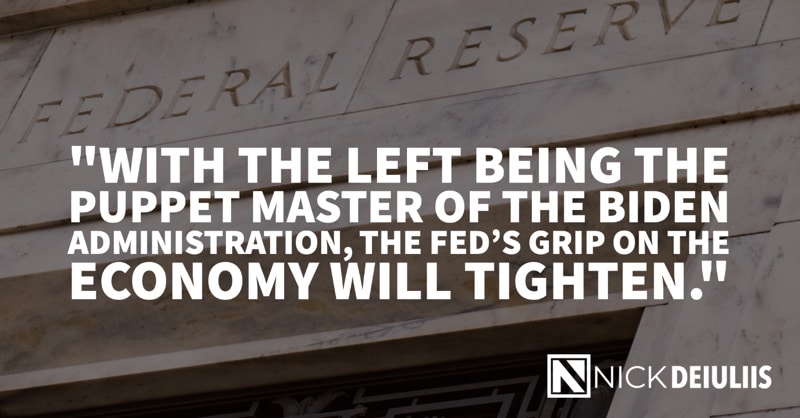
With the Left being the puppet master of the Biden administration, the Fed’s grip on the economy will tighten.  And it will need leadership within its burgeoning bureaucracy that adheres to the proper ideology:  one that believes institutions like the Fed should be utilized to grossly distort the free market, creating winners and losers, both intended and unintended.

And for Ms. Raskin and like-minded future nominees, they look to push the Fed’s path of value destruction deeper and further than ever.

For example, Ms. Raskin advocated for penalizing or precluding banks’ lending to domestic energy companies, whether they be in natural gas, oil, pipelines, or refining.  All in the name of saving the planet.  She stated, “There is no indication that the value of fossil fuel assets is ever going to return,” and wrote how fossil fuels are a “terrible investment.”  How inept that expert prediction now looks in 2022, proving once again how out of touch the expert class is when it comes to the real world.  Should she had been confirmed, she likely would have pushed to have the Fed restrict capital flows into the never-more-vital domestic energy industry.

The danger has not passed.  Unfortunately, there is a long line of potential nominees that Congress will surely soon consider who share similar, or perhaps more extreme, views to Ms. Raskin.  We need nominees willing to scale back the mission creep of the Fed, not those blindly advancing it beyond its circle of competency.

Not only is controlling future weather not in the Fed’s power alley, many worry that reining in self-inflicted inflation may not be a core competency either.  The more the Fed’s mission veers from its shaky circle of competence, its performance will worsen and its politics will dominate. That’s bad for taxpayers, the middle class, business owners, individual rights, and wide swaths of this great nation including my home of western Pennsylvania.

This is not a typical Democrat-Republican issue.  Instead, this is a government-citizen issue and affirming who answers to who.  Congress needs to pass this civics test when it comes to holding the Fed to a reasonable mission and when assessing future Fed nominees.

Nick Deiuliis is the author of Precipice: The Left’s Campaign to Destroy America. For daily insights and commentary from Nick follow him on Twitter at @NickDeiuliis.

Medical Malpractice Claims the Hippocratic Oath: Part Two

While the medical journal community lectures on climate change, a complex subject it has no expertise in, it ignores crises affecting the health and welfare of society’s most vulnerable.

Big Tech’s Business Model of Teen Addiction    

Big Tech is making society dumber by the day and the numbers prove it:  Spotify reported the most popular rendition of Beethoven’s fifth symphony has been streamed 1.5 million times; compare that to Olivia Rodrigo’s hit Driver’s License being streamed 800 million times—in less than six months!

Worse yet, the business of social media hinges on making it addictive, particularly to young adults and kids. Most realize that, and savvy docs especially should.  The average American adult now spends over two hours a day on social media, and they don’t come away enriched or feeling better about themselves.  Avid social media users become more addicted and suffer compounding physical and mental health maladies.

The Facebook whistleblower told us what we already know:  the tech giant does not have our best interests in mind and looks to hook and draw us in to grow revenue and stock price.  Its business comes before the customers’ health and wellbeing.

What should doctors be more worried about today when it comes to teens and kids?  What Instagram is doing—by design—to their mental health and self-esteem?  Or what a colorless, odorless benign gas will increase to on a parts-per-million trace level in the atmosphere over the next century?

Broken Big City Public Education Systems

The public education system in America’s largest urban areas is broken, incapable of arming students with competency in reading and math, and condemns millions of poor and minority students to a life of unfilled potential.

The National Assessment of Educational Progress ranks the nation’s public schools in proficiencies for subjects such as math and English, as well as for different grades and demographics.  You can find scorecards for the big city school districts under the Trial Urban District Assessment.

The results for 2019 across 27 of our largest big-city school districts are an outrage.  Not a single city of the group could say that a majority of its black 8th-grade students were proficient in math or reading.  Not math and reading; math or reading.  By way of example, New York City’s public schools posted an embarrassing 10 percent math proficiency and 14 percent English proficiency for black 8th graders.

More shocking are the abysmal results of the best cities of the twenty-seven.  Charlotte: 24 percent black 8th grader proficiency in math—tops across the cities. Boston: 20 percent black 8th grader proficiency in reading—first place in the group.

This should be a national outrage, particularly considering the importance of the need to address racial inequality.  Unwillingness to demand good proficiency in math, science, reading, and English for minority students in big-city schools is a grave failure of heart and destroys their potential for acquiring decent quality of life.

The medical profession is guilty of such a failure.

These writers deflect from the real health and welfare issues on the underserved, such as our broken urban public education system, and instead distract with abstract procrastinations on future climate.

American Mobility Grinds to a Halt

In Atlanta, home prices are up 23 percent year-on-year while incomes are up only 3 percent.

The U.S. housing market has become so prohibitively expensive that it is suffocating upward mobility and economic inclusion.

Skyrocketing home prices and plummeting affordability are fueled by flawed government policies, including regulations in the name of ‘tackling climate change’ and ‘sustainability.’

The math is simple.  In Atlanta, home prices are up 23 percent year-on-year while incomes are up only 3 percent.  Potential homeowners lose, big time.  Nationally, the median American household assigns over 32 percent of its income to cover the mortgage, the highest level since late 2008 (and we know what happened in 2008).

And less affordable housing brought on by harmful environmental policies is killing economic mobility, the crucial attribute that allowed Americans since there was an America to get ahead: New England colonists moved to the western frontiers of Appalachia; poor European immigrants came to the cities and their kids to the suburbs; freed slaves after the Civil War headed north; Oklahomans escaped the Dust Bowl and chased the California dream.

Today a similar path for the working poor does not exist.  Mobility is down a third since 2007.  Why?  Because the rich and well-to-do in desired regions or cities made their property more valuable by creating scarcity through onerous regulations, many under cover of saving the planet.  That denies others the chance to move up a rung or two on the economic ladder by utilizing mobility.  The rich’s assets get inflated while the rest stay stuck on their prescribed rung.

Plummeting home affordability and the subsequent frozen economic mobility takes a cumulative toll on the health and wellbeing of working families. The damage will be measured in lower life expectancies, increased stress-related illnesses, and other medical and quality of life problems.

Where’s the medical profession’s editorial on this current and tangible threat induced by flawed policy falsely touted as being environmentally-just?  You won’t find it.  Instead, the medical profession calls to give the same governments that killed homeownership and economic mobility even greater control, this time to save the planet.

Great Harm and Widespread Injustice

Through the Hippocratic Oath, the Greeks paved the path from the mystical to the scientific for the medical profession.  The foundational rule of ‘do no harm or injustice’ has been disrespected by the editors of today’s medical journals and their misguided musings.  What they call for will do great harm and impose widespread injustice.

Instead of the leaders of the medical community distracting the profession by chasing issues they know little about, society should demand they refocus their energy and attention on finding the cures for Covid, cancer, dementia, and autism.

Leave embracing of the Left, extreme environmentalism, and climate change zealotry to the fringes of nonproductive society, where they belong.

Medical Malpractice Claims the Hippocratic Oath: Part One

The most famous section of the Hippocratic Oath, that classic Greek ethical template for the medical profession, pledges to “do no harm or injustice.”[1]  Unfortunately, leaders of the global medical community have committed grave moral failure and brazenly violate the Oath.

The malfeasance does not pertain to subject matter we would hope the medical community is focusing on: researching and improving treatments for cancer, Covid, autism, Alzheimer’s, diabetes, heart disease, and a host of other maladies that threaten individual health every day.  Instead, the malfeasance is rooted in the world’s leading medical journals calling for drastic treatment of…climate change.

The editors of over 200 global medical journals—including stalwarts like The New England Journal of Medicine, The Lancet, and The British Medical Journal—jointly penned an editorial in September 2021 that called for emergency action on climate change.[2]

The editors of over 200 global medical journals jointly penned an editorial in September 2021 that called for emergency action on climate change.

There is much to loathe in the editorial. It drips with a toxic combination of extreme environmentalism and leftist principles.  Ideology bordering on religion steamrolls over science and logic throughout.  That the global medical field thought leaders see climate change predictions and energy policy expertise as core competencies is shocking.

That they place climate change above pandemics and poverty as a larger health crisis is alarming.

That they demand imposing government control and socialist doctrine across economies and societies is disgraceful.

The editorial is a textbook study in creative writing; it should be used as a teaching instrument in college English departments.

If you think this summation an exaggeration, consider the following excerpts from medicine’s Apocalyptic manifesto, which are all debunked with facts:

“Health is already being harmed by global temperature increases”

The authors postulate that carbon-based energy and corresponding higher trace CO2 concentrations affect climate, which then harms humans.  They ignore extensive data across decades and continents that show carbon (and the resulting CO2 emissions increase) allows people to live longer, their babies to suffer lower rates of infant mortality, their kids to be better educated, their economies to be wealthier, and their citizens’ individual rights to be better protected.  If you believe access to reliable and life-sustaining carbon-based energy increases global temperatures, you should be advocating for more of it, not less, when it comes to human health.

“The science is unequivocal”

The medical profession should know better than most that science is never meant to be unequivocal.  Science is not about consensus and the static; it is about challenging the consensus and constant refinement.  That’s why doctors not long ago attached leeches to patients to cure them of ailments, while today a doctor would lose her license and be sued to financial ruin if she performed such an act on an unwitting patient.

“Only fundamental and equitable changes to societies will reverse our current trajectory”

This statement betrays the leftist mentality embraced by much of the medical community.  It’s a familiar playbook of the extreme left and right for over a century: manufacture a crisis that requires drastic action, proffer up squishy but subliminally malignant concepts like ‘equity’ as guides, and then go about remaking society as you see fit.  Marx and his movement (a.k.a. communism) successfully murdered hundreds of millions utilizing the playbook that is appropriated in the editorial.

“Governments must intervene to support the redesign of transport systems, cities, production and distribution of food, markets for financial investments, health systems, and much more”

This quote is the most chilling from an overall frightening document.

The medical profession is calling for a complete overhaul of societies and economies, forcing change by the brutal arms of government.  Let’s surrender to big-city mayors and bureaucracies complete unilateral control of urban America.  Stalin and Mao did such a fine job feeding their people, let’s turn over food production to the state.  The New York City subway system is such a superior experience to ride hailing, so let’s mandate public transport for all. Let the government-run health care—it will surely be a higher level of care to what the private sector now offers (even though our current health care system is the envy of the world).

“No temperature rise is ‘safe’”

Yet extreme cold kills over three times as many people every year as extreme heat (ironically, the medical journal The Lancet reported this recently, which is one of the co-authors of the climate change editorial).   Thus, logic would indicate that a small level of warming will produce a net saving of lives.

“The cost of renewable energy is dropping rapidly”

No, it is not.  Renewable energy, such as wind and solar generation, has proven to be epically unreliable at the worst possible times, as evidenced recently in California, Texas, and the UK.

Renewable costs are increasing, in part because governments across the globe mandate their market share, and the materials required to manufacture components are scarce and sit in faraway hostile lands (i.e., China).

The cost of renewable energy is hidden by a Byzantine maze of state subsidy and regulated industries.

Make no mistake, that cost is high, it must be netted out in the end, it is growing rapidly, and it will be ultimately shouldered as a hidden regressive tax on the working poor and middle classes.

The recent medical journal editorial on climate change shows that the medical profession is rapidly sliding down a slippery slope, jettisoning objective analysis and the scientific method and embracing political science and ideology bordering on religion.  If the slide continues, all of us will suffer life-altering consequences: adoption of harmful government policies and less competent medical care.


Look for part two of “Medical Malpractice Claims the Hippocratic Oath” coming the week of March 7, 2022. 

For related analysis by Nick, see, “A Rational Person’s Guide To Climate Change.”

[1] The Hippocratic Oath, U.S. National Library of Medicine, https://www.nlm.nih.gov
[2] Call for Emergency Action to Limit Global Temperature Increases, Restore Biodiversity, and Protect Health, September 6, 2021, https://www.nejm.org/doi/full/10.1056/NEJMe2113200